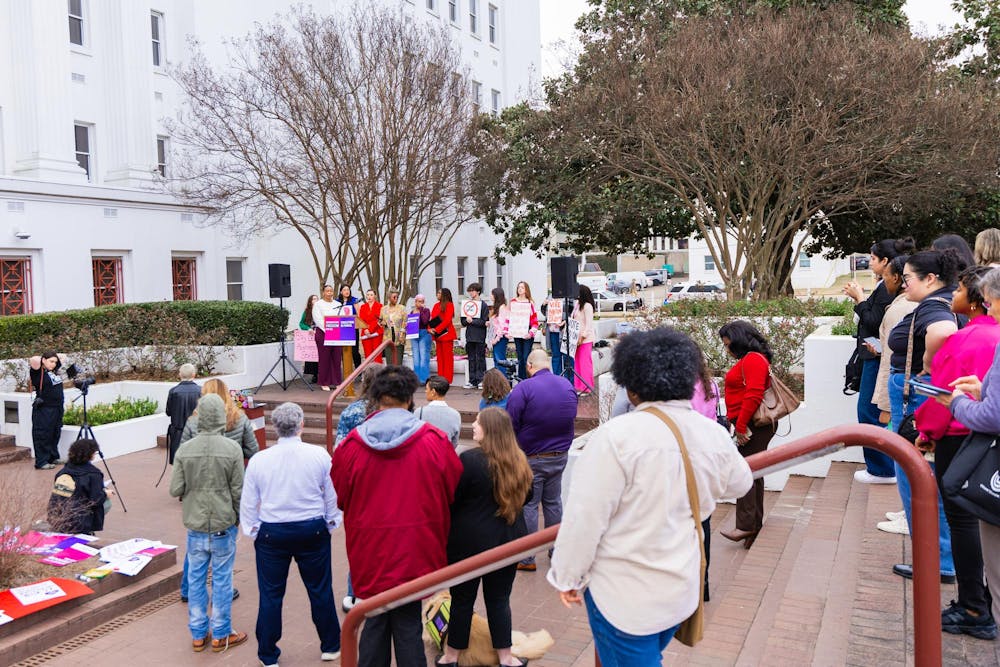
On Feb. 10, reproductive advocacy organizations held an advocacy day at the Alabama State House to urge Alabama legislators to vote against SB209. The bill would require abstinence-only education and restrict sex education in public schools.
Organized by Unite for Reproductive and Gender Equity (URGE), the Our Bodies, Our Futures Advocacy Day included a brief press conference and rally on the steps of the State House at 9 a.m.
The speakers included URGE Southeastern States Movement Building and Policy Director Courtney Roark, ACLU of Alabama Executive Director JaTaune Bobsy-Gilchrist, Alabama Values Progress Executive Director Anneshia Hardy and Dr. Sha’Rose Erion, a pelvic floor physical therapist specializing in Black maternal health and transgender health and rights.
Justala Dean, communications strategist at the ACLU of Alabama, was the master of ceremonies for the event.
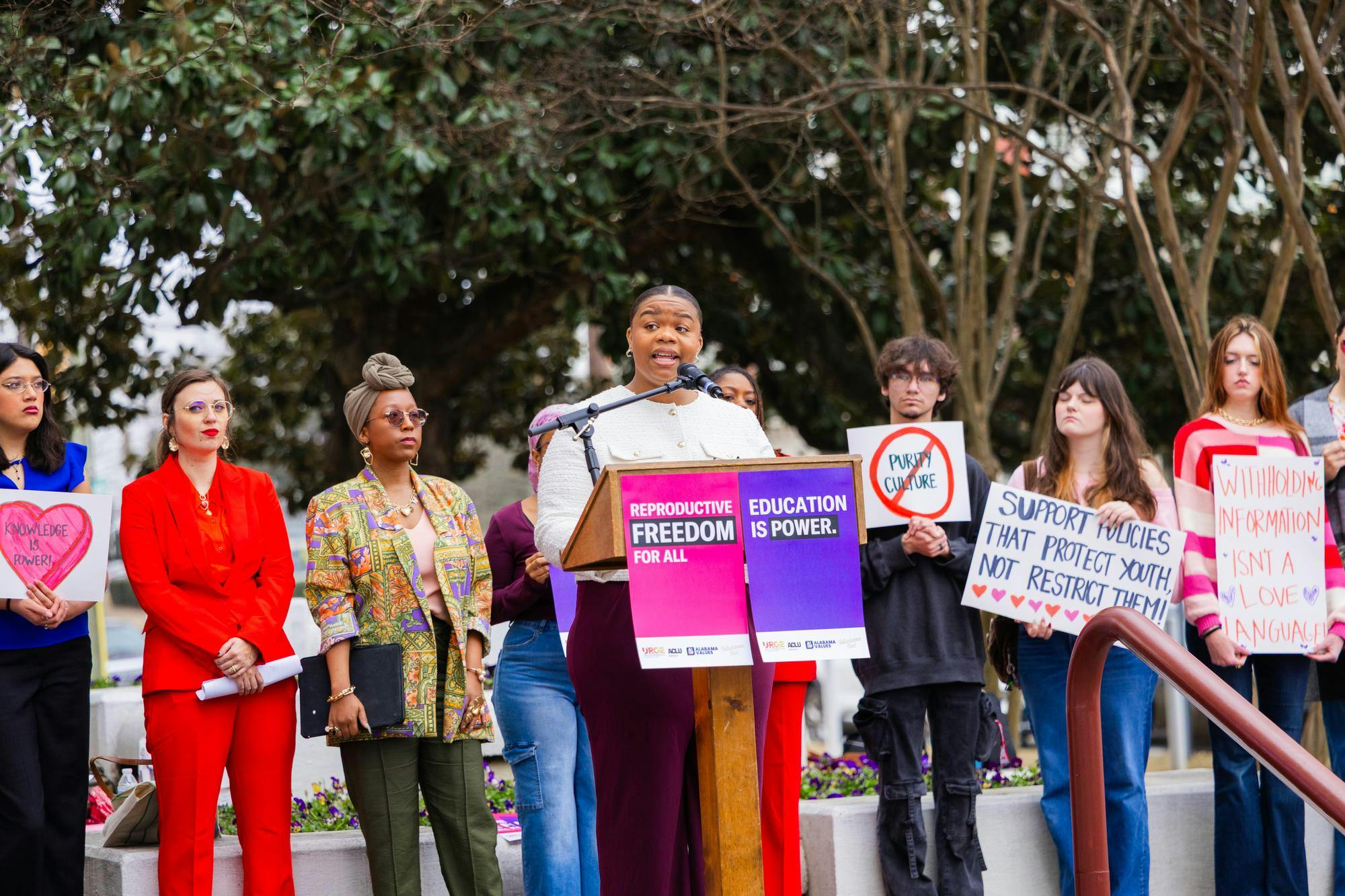
Justala Dean, communications strategist at the ACLU of Alabama, speaks as the MC of the Our Bodies, Our Futures Advocacy Day on Feb. 10, 2026.
Each speaker stood at a podium bearing signs that read “Reproductive freedom for all” and “Education is power.” The speakers argued that SB209 harms Alabama’s youth and limits people’s reproductive and educational freedoms.
SB209 would require public K-12 schools to teach abstinence-until-marriage education and prohibit any sex education from kindergarten to fourth grade. The bill would prevent education on how to use and obtain contraceptives. It would also ban education about how to obtain an abortion and requires teaching about Alabama’s abortion law. Alabama bans all abortions except for miscarriages, ectopic pregnancies or terminations due to lethal fetal anomalies.
Bobsy-Gilchrist said that SB209 would be worsen Alabama’s already high STD, STI and teenage birth rate.
“These outcomes are not accidental,” Bobsy-Gilchrist said. “They are tied to limited access to information and care. I would be remiss if I did not connect this conversation to the fact that we have a lack of abortion access, reproductive care and sexual health information in this state.”
As a physical therapist, Erion has treated many adult Alabamians who do not understand their own anatomy. They often miss early warning signs for pelvic floor dysfunctions like chronic pain and urinary leakage, which start in adolescence. In her opinion, the issue begins in schools.
“Folks are getting less education, less understanding and not are being able to make their own decisions on their bodies,” Erion said. “My medical experience leads me to believe that this leads to a lifetime of preventable health struggles.”
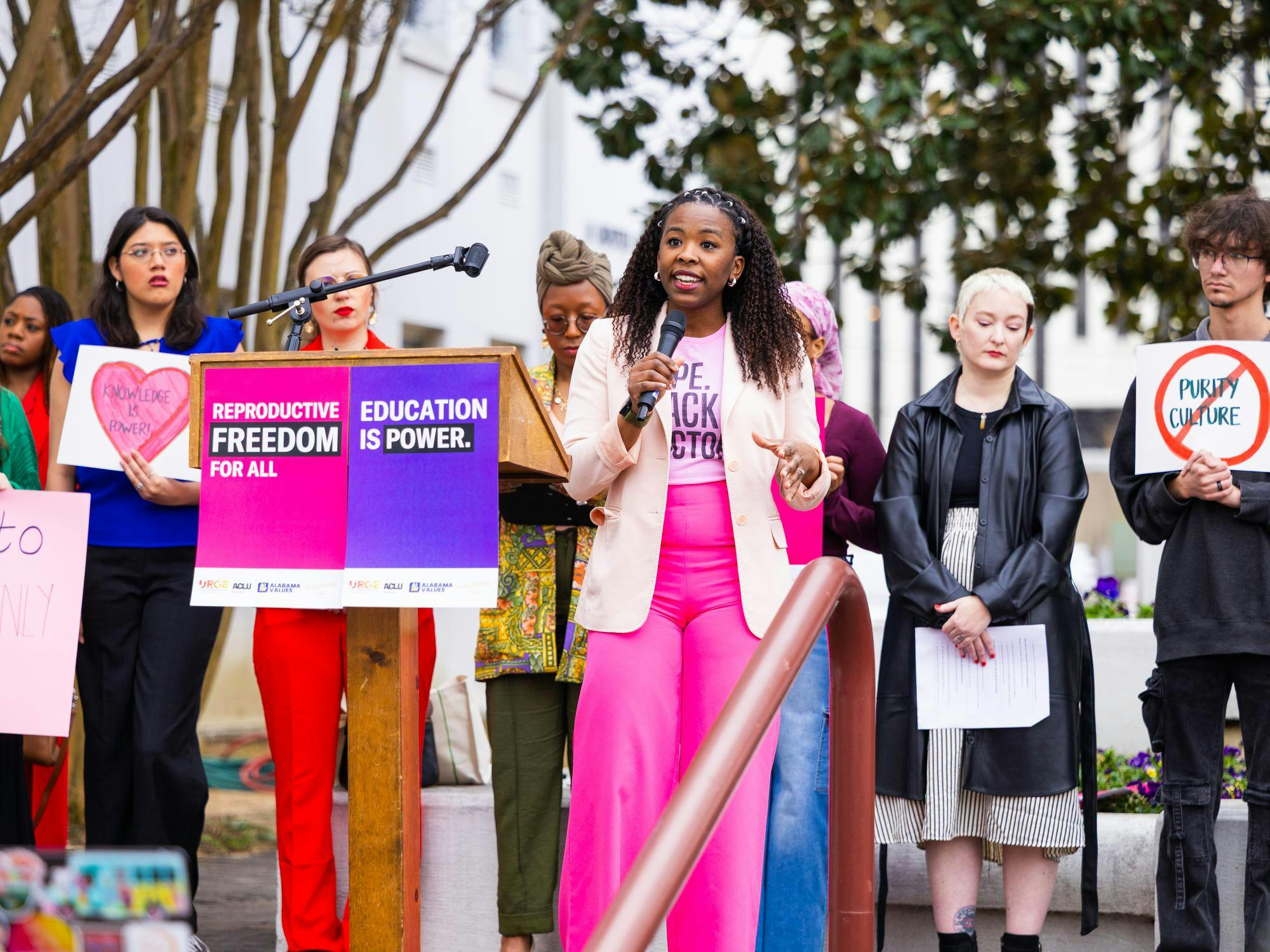
Dr. Sha’Rose Erion, a pelvic floor physical therapist, speaks at the Our Bodies, Our Futures Advocacy Day on Feb. 10, 2026.
Roark believes that without comprehensive sex education, misinformation about contraceptives, STIs, gender and consent will harm young people, especially for those from poor, rural or marginalized backgrounds.
“This can often lead to sexual shame and trauma which perpetuate through generations,” Roark said. “A lack of information or only information that is highly stigmatized creates so much opportunity for violence to happen to our young people.”
To Hardy, SB209 is part of a larger historical pattern of Alabama legislators making decisions about Alabamians’ bodies and families.
“From these very steps, lawmakers have passed and continue to pass bills that are oftentimes rooted in fear, control, exclusion,” Hardy said. “Across generations, we have seen coordinated efforts to restrict information, to police our bodies and limit our autonomy through policy.”
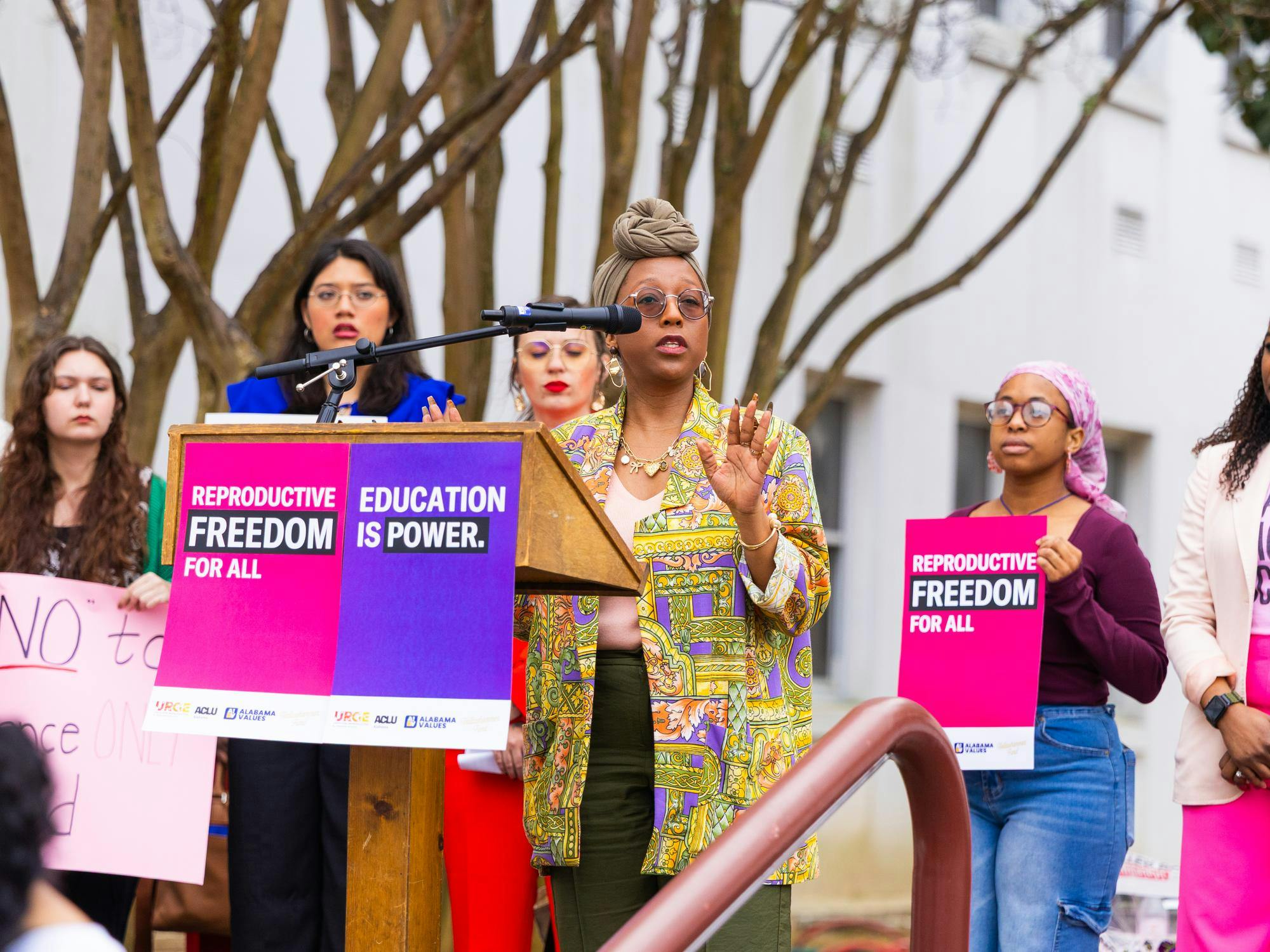
Anneshia Hardy, Executive Director for Alabama Values Progress, speaks at the Our Bodies, Our Futures Advocacy Day on Feb. 10, 2026.
Throughout the press conference and rally, attendees held up signs protesting SB209 and advocating for reproductive and educational freedom. Some attendees were college students like Cameron Stulting-Flores, a master's of public administration and political science junior at the University of Alabama. Stulting-Flores is also the director of political education at the University of Alabama’s URGE chapter.
“I thought it was really important to come out here and practice what I preach,” Stulting-Flores said. “We hand out Plan B’s and condoms, but I think it’s even more important to start at the source of legislation and try to enact change.”
After the rally, attendees went to legislative advocacy meetings in the State House from 10 a.m. to 2 p.m. At the meetings, attendees advocated against SB209 and in favor of comprehensive sex education.
A previous version of the bill required teaching that abstinence outside of marriage is the “expected social standard.” The current version states that it is the “best health practice” for unmarried school age individuals. Moreover, the bill requires teaching that rearing children in married, two-parent households is beneficial over alternatives.
Even if SB209 passes, Roark believes that people can still come together to provide resources and enact change.
“We still have the political power that we have in our bodies and our communities to take care of one another, to provide mutual aid, to do community organizing, to teach one another the things we need to be taught in order to live thriving, joyous, pleasurable lives,” Roark said. “We still have the power to effect change on state boards of education on the local level.”
This is the third time the Alabama Legislature has introduced a bill that would require abstinence-only education. The previous bills were HB195 in 2024 and SB277 in 2025.
URGE organized the event in partnership with Yellowhammer Fund, the American Civil Liberties Union of Alabama, Alabama Values Progress and the Alabama Reproductive, Health, Rights and Justice Coalition amongst other statewide organizations.
Do you like this story? The Plainsman doesn't accept money from tuition or student fees, and we don't charge a subscription fee. But you can donate to support The Plainsman.