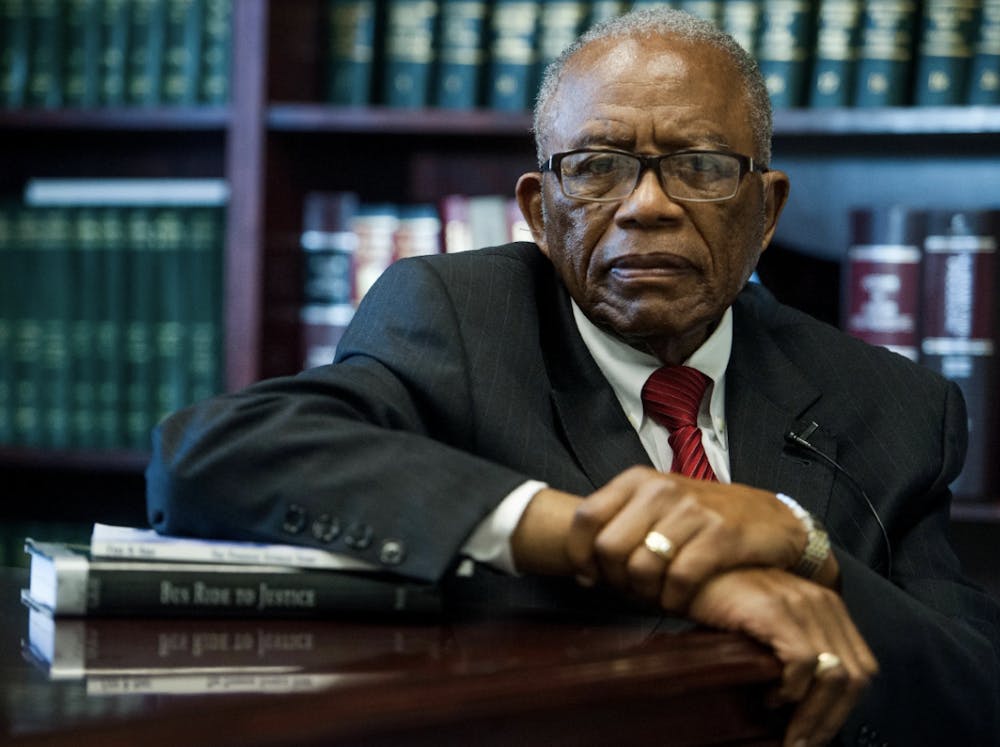
On the afternoon of Wednesday, Sept. 17, Civil Rights Movement attorney Fred Gray spoke at Auburn University’s annual Constitution Day lecture in the Foy Hall Ballroom. At the lecture dedicated to the signing of the United States Constitution, Gray spoke about his legal career in arguing for the constitutional rights of African Americans.
Students and faculty alike flocked to the event to hear the legendary attorney speak and take questions from the audience.
In Alabama and across the United States, Gray's accomplishments as a civil rights attorney have spanned both deep into the heart of systemic racism and segregation, setting national precedents that courts still cite today. Some of his most well-known casework includes the defense of Montgomery bus boycott protestors, including Claudette Clovin and Rosa Parks – whose statute now stands in the United States Capitol. Gray also worked with Martin Luther King, Jr. in 1960 at the beginnings of the Civil Rights Movement.
Gray was a spearhead in the desegregation of Alabama public schools and higher education institutions, including Auburn University. His work paved the way for Harold A. Franklin to be the first African American student admitted to Auburn in 1964.
After a short introduction by Dr. Steven Brown, the law and justice program director, Gray took the stage to discuss his powerful career in civil rights and the importance of adhering the United States Constitution in all aspects of the law.
With a slow, steady Southern drawl and the assertive tone that only a lawyer of 71 years could possess, Gray recalled his early life and the notable roadblocks he overcame to become a practicing lawyer in a segregated state.
Gray reflected that, from 1950 to 1960, black men could only rarely step outside of employment as teachers or preachers, yet there were few lawyers to represent the massive amounts of racial injustice in Montgomery, Alabama.
Gray noted to the audience that while an undergraduate student at Alabama State University, which at the time was the Alabama State College for Negroes, he made a secret pledge to himself to destroy every part of segregation he could find by going to law school and becoming an attorney. He noted that the Constitution was always at the center of his practice, saying he “used the Amendments [13th, 14th and 15th] to break down walls of segregation.”
After his lecture, Gray took questions from the audience regarding his experiences, the current state of racial injustice and the role of the Constitution in legally reforming the nation.
As the event closed, students and faculty mingled and lined up to take photos with the American civil rights trailblazer. One law and justice student noted the impact of the lecture.
“It was a big honor to be with him [Gray]," she said.
She continued by adding that her takeaways from the lecture were "[about] making the community more united and helping out the community wherever you can.”
Ending his lecture with a challenge to the audience, Gray noted that in contemporary America, the “struggle for equal justice continues" and "no one can do the work alone.”
As a part of the next generation of America, Constitution Day serves as an opportunity for the Auburn community to reflect on what the Founding Fathers had in mind when they signed the Constitution over two centuries ago and how justice and equal rights for all can prevail in our community and our nation.
Those interested in learning more about Gray can purchase his autobiography "Bus Ride to Justice: Changing the System by the System" to read about his life and legacy on both the legal field and the national stage.
Do you like this story? The Plainsman doesn't accept money from tuition or student fees, and we don't charge a subscription fee. But you can donate to support The Plainsman.