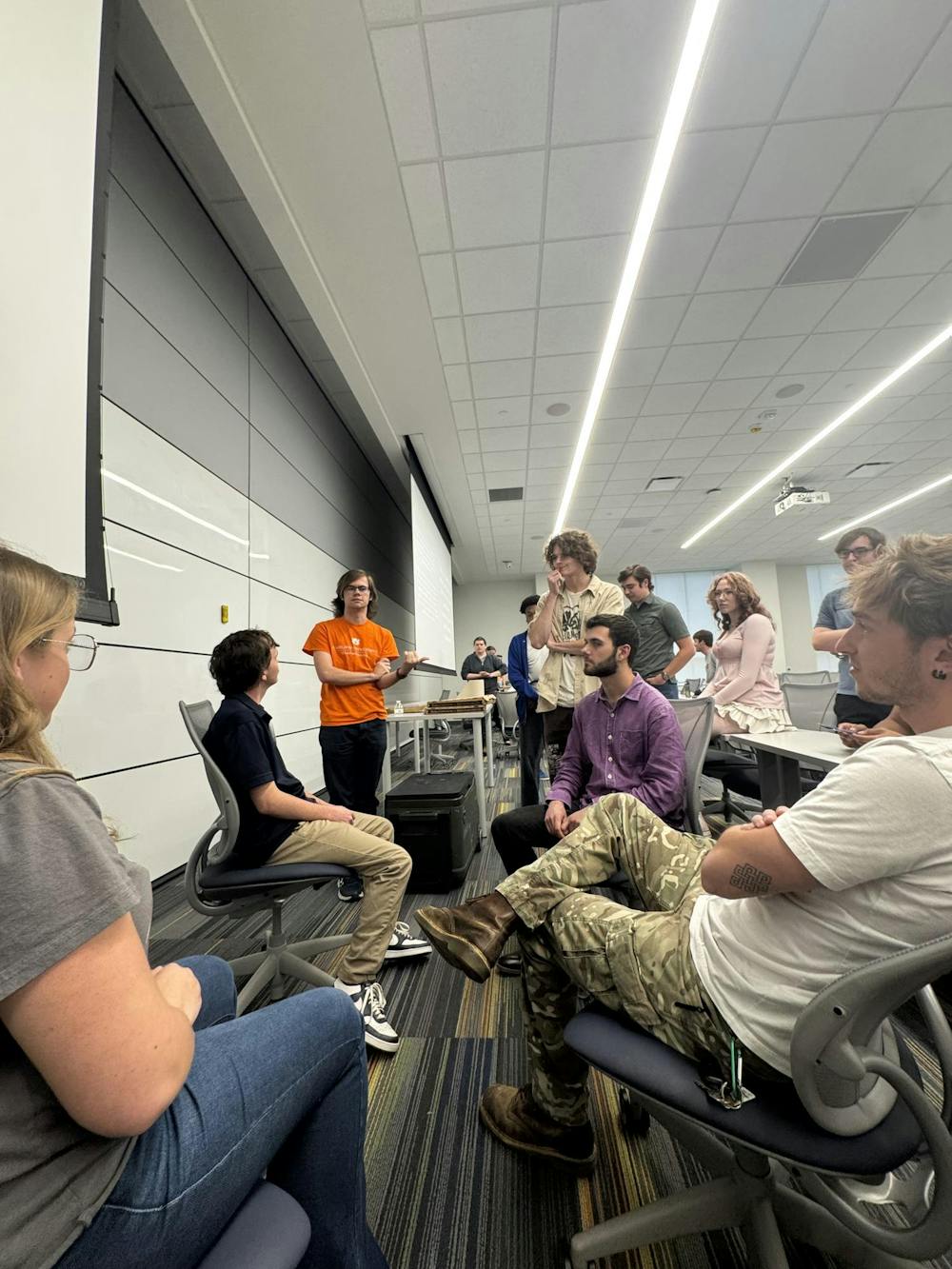
BridgeUSA Auburn, the Auburn University National Security and Intelligence Society (AUNSIS) and Pi Sigma Alpha-Epsilon Nu hosted a joint discussion titled “Engaging Iran: Policy, Intelligence and Regional Stakes,” on March 24, from 6 to 8 p.m. in the ACLC room 108.
The event, open to all students, focused on Iran and its role in current U.S. foreign policy and regional security. As students filed in, they were encouraged to grab free drinks and pizza. By the event's start, around 40 students filled the space, with officers from the different organizations preparing at the podium.
Before the open-discourse portion of the event started, the secretary for AUNSIS, Kate McLain, welcomed attendees and then spoke about the best methods to be informed with unbiased and accurate information. McLain suggested a way to determine whether a source is trustworthy is to assess how much emotion it contains and by cross-referencing it with similar documentation.
Grayson Weithoner, a sophomore in political science and member of AUNSIS's leadership, gave a brief history of the United States’ relationship with Iran. Weithoner would go on to mention that in the 1950s the U.S. and Britain overthrew Iran’s leader who tried to nationalize the oil industry and reinstalled the Shah as the ruler.
During the Islamic Revolution in the late '70s and early '80s, Weithoner said the Shah was overthrown, and the Ayatollahs came into power. It was at this time that the Iran Hostage crisis occurred, where Americans were held hostage for 444 days at the U.S. Embassy in Tehran, and the U.S. and Iran have had tense relations since. Weithoner concluded his portion of the presentation by noting a strategic buildup of military assets in the region leading up to the U.S. attacks on Feb. 28 as part of Operation Epic Fury.
Weithoner, who is heavily involved in AUNSIS, said that events like this are crucial for helping students become aware of the beliefs of those around them. He thinks that a discussion with other students about a pressing global security issue, like the Iran conflict, was much needed and should be more frequent on Auburn’s campus.
“As a member of AUNSIS, I believe [Iran] is a very important topic for national security and intelligence in general. Hearing an opinion from someone, like a biomedical science major, kind of opens your eyes about [a certain topic]. Sometimes, [as a political science major] I feel like I’m surrounded by a [certain viewpoint] all the time," Weithoner said.
Weithoner then gave the floor to Uriah Chumpitaz, a sophomore in computer science and the president of BridgeUSA Auburn, who laid out the ground rules for a civil debate. Following this, Chumpitaz started the first discussion-based activity of the night where different relevant topics were displayed on-screen, and audience members were able choose which corner of the room to stand in based on how they felt about the topic. Between rounds, members from each corner asked questions and shared what they thought about their own position.
The next activity involved splitting the audience into groups, each with chairs facing each other. Once seated in the chairs, the audience members discussed a topic displayed on screen, and the people who weren’t already seated were able to “tap-in” to sit down and participate in the discussion. After the “tap-in” portion concluded, audience members were directed to take their seats at a long table with individual chairs facing each other. For this activity, the audience was able to debate a topic on screen and then rotate down the line of chairs to produce as much discourse as possible.
Near the end of the event, the audience members returned to their original seats, and an open forum-style discussion was moderated by Chumpitaz.
Chumpitaz said he was excited about the turnout at the event and was thankful that BridgeUSA Auburn was able to partner with the other organizations involved, allowing for a more open debate. According to Chumpitaz, BridgeUSA strives to create places where all voices are heard and equally represented. Chumpitaz wants to do more events like this, where liberals and conservatives alike can participate in open discussion.
“This is our first big event that we’ve done. We have had some smaller-scale events, but nothing this big. I think this is a great way to get our name out to the rest of the school. The entire point of BridgeUSA is to bring people together, not to try to change their minds, but to allow people to communicate. This event is showcasing that, no matter what, people can be liberal, conservative, Republican, Democrat, in the middle, anywhere on the spectrum, and still have an extremely peaceful and productive discussion,” Chumpitaz said. “We try to cover current events, so we just recently had discussions on ICE, but when AUNSIS reached out about a discussion on Iran, I immediately said yes. It’s a topic that everyone knows a little bit about, but this [environment] allows you to hear someone else’s perspective and figure out exactly where you fall, rather than just listening to a one-sided organization.”
The topics that audience members wrestled with throughout the many debate-focused activities were wide-ranging; however, all tied back to the Iran conflict in some way. At one point, several students examined the responsibility of the U.S. may or may not have in regard to another country possessing nuclear weaponry. Other students, while tying back to other historical events, deliberated the morality of allowing a country to harm its own citizens.
At one point, more than 10 audience members bounced ideas off one another and weighed the deaths of six U.S. military servicemen against the perceived goals of the war laid out by the Trump administration. Some members of the audience agreed that the reasons for the U.S. entering the conflict seemed ever-changing, while others believed that the country must allow the situation to fully play out to get the full picture. Throughout the night, students often mentioned that in today’s information-heavy environment, it is more difficult than ever to discern the truth, which can make many shy away from being knowledgeable of current events.
At the conclusion of the event, audience members were thanked for being part of what organizers called a "healthy and peaceful discussion," and were asked to fill out a form to help BridgeUSA host more successful future events.
BridgeUSA is a non-partisan movement whose mission is to reportedly foster civic dialogue on high school and college campus across the U.S. Information for BridgeUSA can be found on their AUInvolve page or by emailing them at bridgeauburn@gmail.com.
AUNSIS is an interdisciplinary student organization sponsored by the political science department that provides a platform for students to learn and connect with professionals in national security, defense and intelligence. On March 31 at 5:30 p.m., room to be confirmed, they will be holding a meeting with a current officer from an embassy in the Middle East. More information about other future events can also be found on their AUInvolve page.
Do you like this story? The Plainsman doesn't accept money from tuition or student fees, and we don't charge a subscription fee. But you can donate to support The Plainsman.
Tripp Hedden, junior in finance and business, has been with The Auburn Plainsman since Fall 2025. Hedden previously served as a News Writer and News Reporter. He is currently serving as the Assistant News Editor.