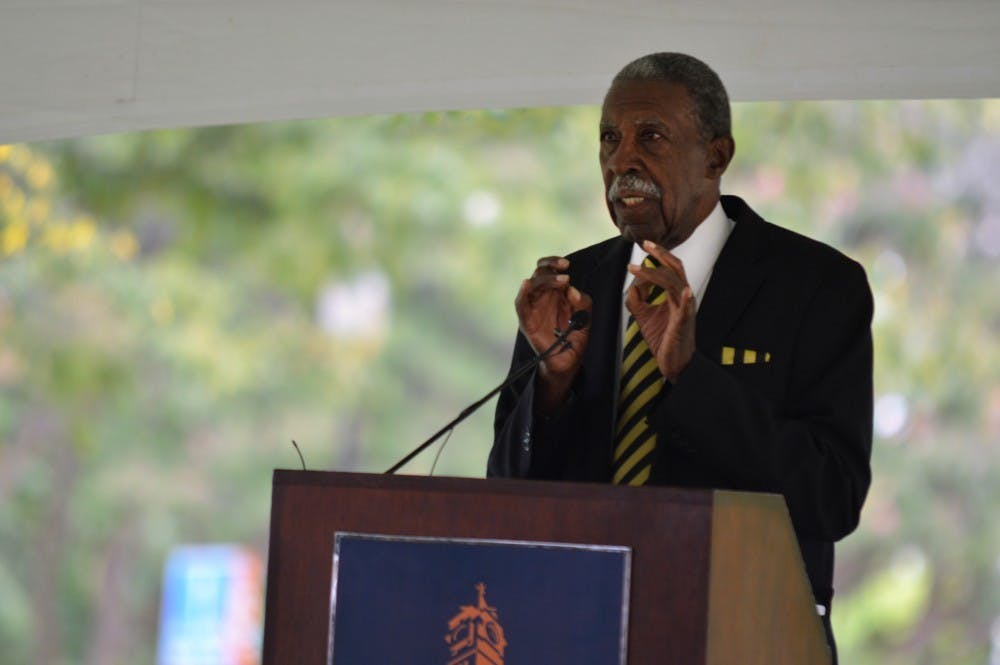
64 years ago, Harold A. Franklin, Auburn University's first African American student, walked onto campus and registered for classes. However, Franklin's first visit wasn’t just meeting with an advisor or scheduling a Zoom call like it is for students today. In fact, to get to the Office of Registration, Franklin had to be escorted by FBI agents to ensure his safety.
Franklin's bravery to walk on Auburn's campus that day mirrors the strength of six-year-old Ruby Bridges, who walked past hostile mobs, as she attended her first day of school at an all-white elementary school in New Orleans. Auburn University, at the time, was not open to allowing black students to attend, but Franklin, Bridgers, and many like them were trailblazers in opening school and university doors to all.
Franklin was born in 1932 in Talladega, Alabama and was raised alongside his 9 siblings. In high school, Franklin decided to leave the classroom to serve in the United States Air Force during the Korean War. In 1962, Franklin graduated from Alabama State College with a degree in government and psychology. He was later convinced by civil rights attorney Fred Gray to attend Auburn University to continue his education.
Despite meeting academic requirements, Franklin’s application was initially denied. The refusal of admission prompted Gray to file a lawsuit against the school, saying the denial “violated constitutional rights.” This case would ultimately lead to Auburn opening its doors to all students, no longer discriminating against students on the basis of skin color and helping lead to the integration of higher education in the South.
Today, outside the Ralph Brown Draughon Library, Franklin’s legacy is recognized on campus through two plaques, which are decorated with statements and stories from his life. The plaques tell the story of the obstacles Franklin faced during his time at Auburn.
Though, some students and faculty argue that the plaque falls short of Franklin’s impact, questioning if the acknowledgements measure up to the courage it took Franklin to walk through the admission doors that day. Even after becoming a student at Auburn, Franklin’s thesis was continuously rejected by the graduate committee in the history department.
Those needless rejections led Franklin to transfer to the University of Denver, where he studied on a scholarship and earned his master's degree in history. Since 1965, Franklin has taught at Alabama State University, North Carolina A&T University, Tuskegee University and Talladega College.
Auburn now offers an endowed scholarship that holds the name of Dr. Harold Franklin, giving students the opportunity to attend school despite financial hardships.
“Auburn is a better institution because of Dr. Franklin’s bravery 57 years ago,” former Auburn President Jay Gogue said in an article by Neal Reid. “His spirit of internal fortitude will continue to inspire us.”
Despite his success in his career, there was still an air of incompleteness from his experience at Auburn University. During his time there, he was continuously denied the ability to defend his thesis in the Department of History, but 37 years later, he was presented with an honorary Doctor of Arts.
The honorary degree was appreciated by Franklin, but something was missing. Dr. Franklin did the work and attended his classes, but he never walked the stage at graduation to receive his degree. It wasn’t until 2020 when Dr. Franklin was finally able to walk and receive his Auburn Creed. He expressed relief, recognizing that his experience has been anything but easy.
“I’m just about speechless after all these years,” Franklin said. “I realized it wasn’t going to be easy when I came here as the first African American to attend Auburn, but I didn’t think it would take this long. It feels pretty good.”
Franklin’s perseverance has paved the way not only for fellow Black students and other marginalized communities but also Auburn University. and its betterment
“I’m glad I could do something to help other people, and my mom and dad always taught us that when you do something in life, try to do something that will help others as well,” Franklin said.
Do you like this story? The Plainsman doesn't accept money from tuition or student fees, and we don't charge a subscription fee. But you can donate to support The Plainsman.
Gracie Goodman, senior in journalism, has been with The Auburn Plainsman since Fall 2025. Goodman previously served as a News Writer. She is currently serving as the News Editor