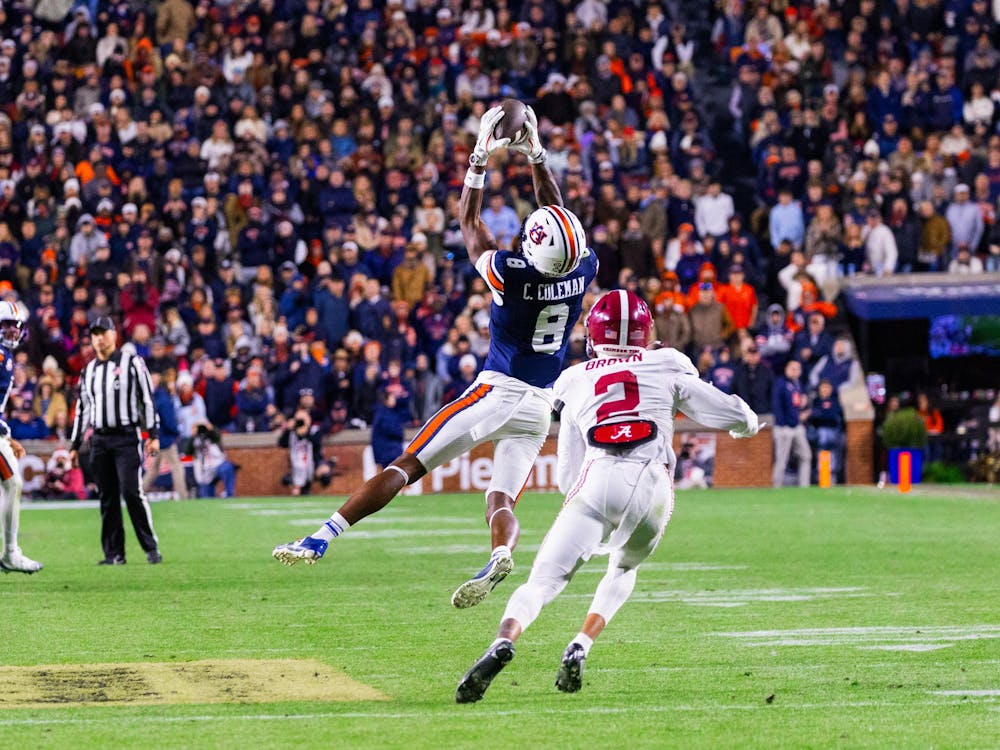
The Iron Bowl is the most important game of the regular season for all Alabama residents and carries great weight for many other college football fans across the country. The rivalry is often heralded as one of the best — if not, the best — in college football.
The two schools have the most combined claimed National Titles at 27 total, with 18 coming from Alabama and nine coming from Auburn. The Tigers and the Tide are also both among the top 15 winningest programs in division one college football at 38 SEC titles combined.
However, regardless of how you view the importance of this rivalry, one thing is clear — and that is its unique nature. The two campuses are separated by just over 100 miles and are in same state, which is different than many other traditional college football rivalries that often occur across state lines.
This creates in-state rivalry creates a competition that begins at birth for many Alabama residents. For example, when one is born and raised in Alabama, from the time they can understand to the day they declare their allegiance, they are asked a simple but important question: “Alabama or Auburn?” The answer to that question, often determined by parent affiliation, then becomes a lifelong fandom on one side of the heated rivalry.
The beginning of the discontent between the programs stretches all the way back to 1862 when the state legislature was deciding which location to give land to under the Morrill Land Grant Act. Many University of Alabama supporters and alumni assumed it would go to them, as they were the largest university in the state. To their surprise, it instead went to the then-named East Alabama Male College in Auburn. For decades after, political disruption between the colleges increased, as they argued over funding, resulting in more and more tension and serving as a blossoming point for the rivalry.
In the history of the Iron Bowl, the two teams have faced off a total of 90 times, with the first matchup in 1893 when Auburn won 32-22. The all-time record belongs to Alabama, who leads 52-37-1.
The great rivalry has spawned many ridiculous and innumerable moments both on and off the field. One of the wildest moments off the field came out of a financial dispute following the series-only tie in 1907, which led to a 41-year hiatus in games between the universities.
Of course, the Iron Bowl would not be the Iron Bowl without the countless memorable moments on the gridiron. An array of games are etched into every fan’s memory, and while some fans would like to forget some, they will cherish others, such as Bo Over the Top, Wrong Way Bo, and the all-time Auburn favorite Punt Bama Punt. In just the last decade and a half, we have seen the historic Gravedigger play in 2023, the four overtime game in 2021, and the Camback in 2010.
Among all of these in recent memory, one stands out among the rest as arguably the greatest moment in the history of the sport: the 2013 Kick Six, when Auburn returner Chris Davis returned a missed field goal 109 for a game-winning touchdown. Throughout the history of Auburn and this rivalry, there has been no shortage of excitement, and many of those iconic moments can be attributed to the best rivalry in college football: the Tigers and the Tide.
Do you like this story? The Plainsman doesn't accept money from tuition or student fees, and we don't charge a subscription fee. But you can donate to support The Plainsman.
Reid is a sophomore majoring in accounting. He joined the Plainsman in the fall of 2024.
You can follow him on X (Twitter) at @ReidFarris2