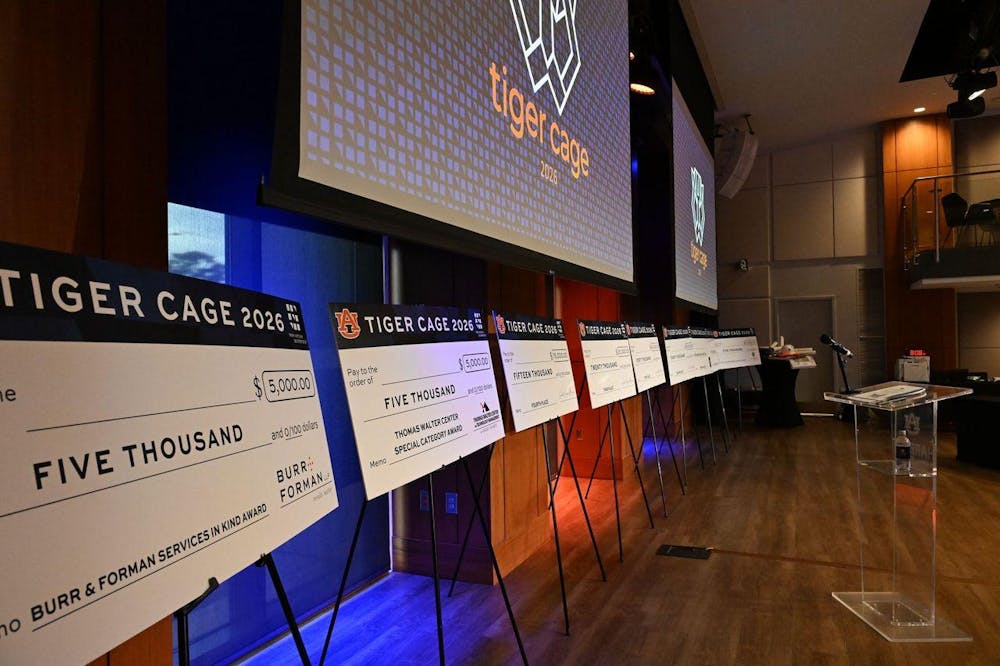
Tiger Cage, Auburn University’s version of the popular television show "Shark Tank," is holding its finals this Wednesday, March 25, in the Broadway Event Space and Theater located in Horton-Hardgrave Hall. From 9:15 a.m. to 12 p.m., five Auburn University students will pitch their innovative early-stage product or service ideas to compete for up to $135,000 in startup capital, which will be awarded at 1:35 p.m.
Here is a look at the five businesses that worked their way to the final:
1. Builder Help
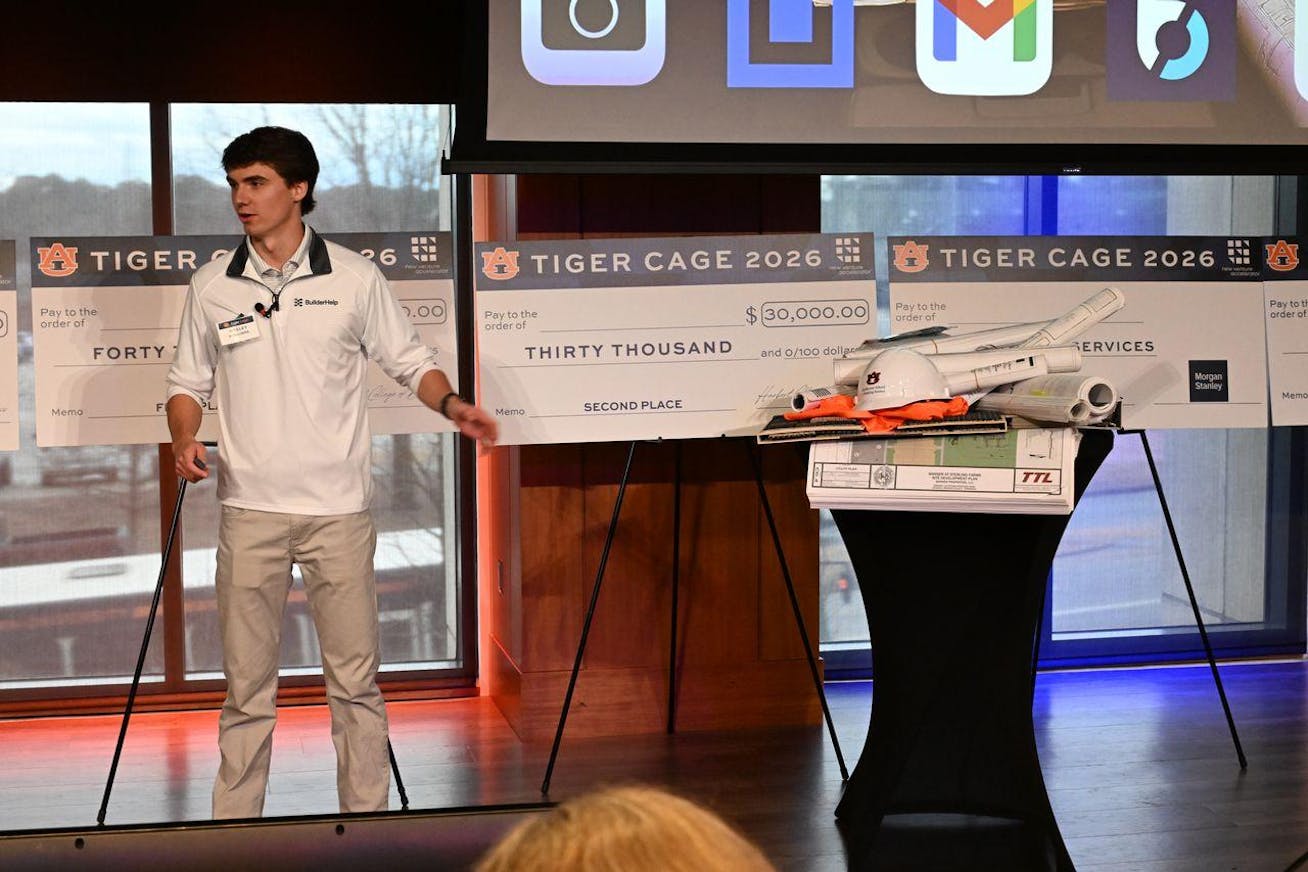
Co-founder Wesley Stallings pitches his online service BuilderHelp at the Tiger Cage Semifinals. Contributed by Auburn University's New Venture Accelerator media and marketing team.
Co-founder Wesley Stallings, senior in building science, noticed that small and midsized general contractors lacked the proper tools to manage the day-to-day operations of their business; online management platforms available were tailored to larger firms and at times were overly complicated and inefficient.
“I’ve always known I wanted to be in construction, and this felt like a calling, combining my passion for building with solving a real problem contractors face every day," Stallings said.
Together with co-founder and Chief Technology Officer Trey Jackson, BuilderHelp has successfully partnered with both residential and commercial contractors in the cities of Auburn and Montgomery under a subscription model. They conservatively project over $4 million in gross revenue within the next three years.
2. GloryEV
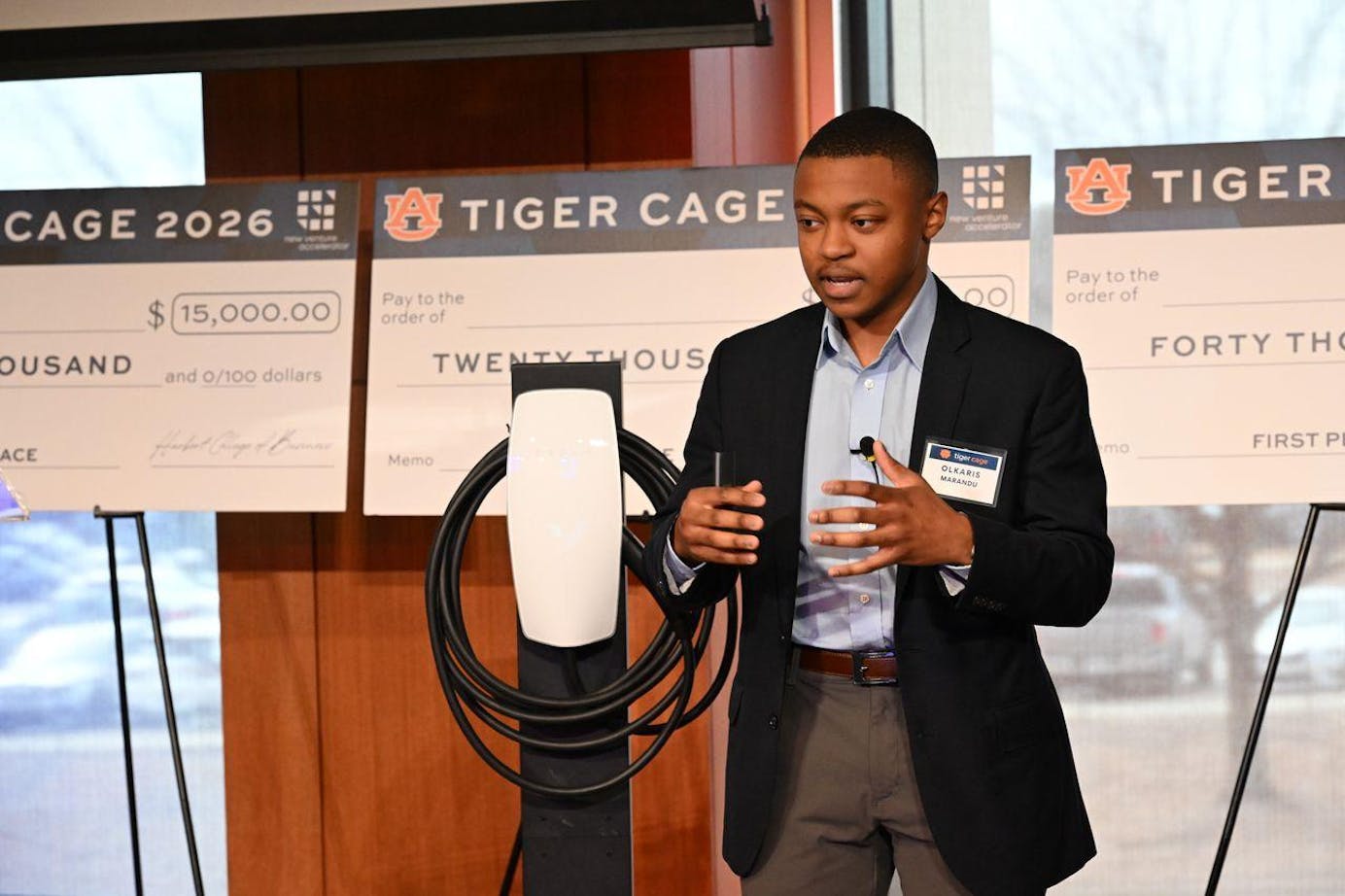
Founder Olkaris Marandu pitches his electronic charging operational service business GloryEV at the Tiger Cage Semifinals. Contributed by Auburn University's New Venture Accelerator media and marketing team.
GloryEV provides the operation of reliable and affordable charging stations for electric vehicles for hotels and other public areas. These novel charging gadgets are AC chargers that can connect to a building’s electrical system and safely transfer power to the electrical vehicle that converts the power into usable energy.
Founder Olkaris Marandu, senior in business management, noticed a substantial rise in electric vehicle usage, but also a lack of available charging stations at hotels or work areas across the nation. With this primarily “charging as a service” model, GloryEV owns, operates and maintains these chargers at hospitality establishments, giving guests and individuals the ability to charge their electric vehicles outside of their homes.
GloryEV’s chargers have been installed for corporations with hotels located across Alabama and Georgia, including: Omega Hotel Group, Ascent Hospitality, Jackson Hospitality and Baron Hospitality.
With over 100 locations combined, GloryEV has an annual recurring revenue of at least $850,000. Together with successful partnerships like Tesla, xeal, Charge Ahead Partnership, Auburn University’s New venture accelerator and AlabamaLaw, GloryEV estimates around 150 future projects, worth $100,000 in annual revenue potential.
3. SCAP Athletics

Co-founder Adam Cardini pitches his athletic recovery tool ScapStick at the Tiger Cage Semifinals. Contributed by Auburn University's New Venture Accelerator media and marketing team.
SCAP Athletics is a sports-focused company dedicated to creating products supporting athletes in recovery – starting with their first invention, the ScapStick. The tool is a five-foot-long portable stick designed to target areas related to shoulder pain and rotator cuff mobility, particularly the deep shoulder tissue of the subscapularis muscle.
Co-founders Adam Cardini, a sophomore in business management, and Nick Dargel, a student-athlete at Wesleyan University in Economics and Spanish, noticed a gap for this kind of specialized tool in the athletic market, and bootstrapped the business to publicize and sell this latent need.
“Athletes were trying to solve a specific problem with tools that were never designed for it,” Cardini said. "That gap became the opportunity.”
Since July of 2025, ScapStick has generated $27,000 in revenue, and the product has been adopted by over 15 Major League Baseball players across 10 different teams and at least 20 Division I athletic programs, including seven SEC programs. They operate primarily through direct-to-consumer e-commerce, social media outreach, generating 1.1 million organic social media views, and partnerships with athletic programs, strength coaches and physical therapists.
4. Side Kit
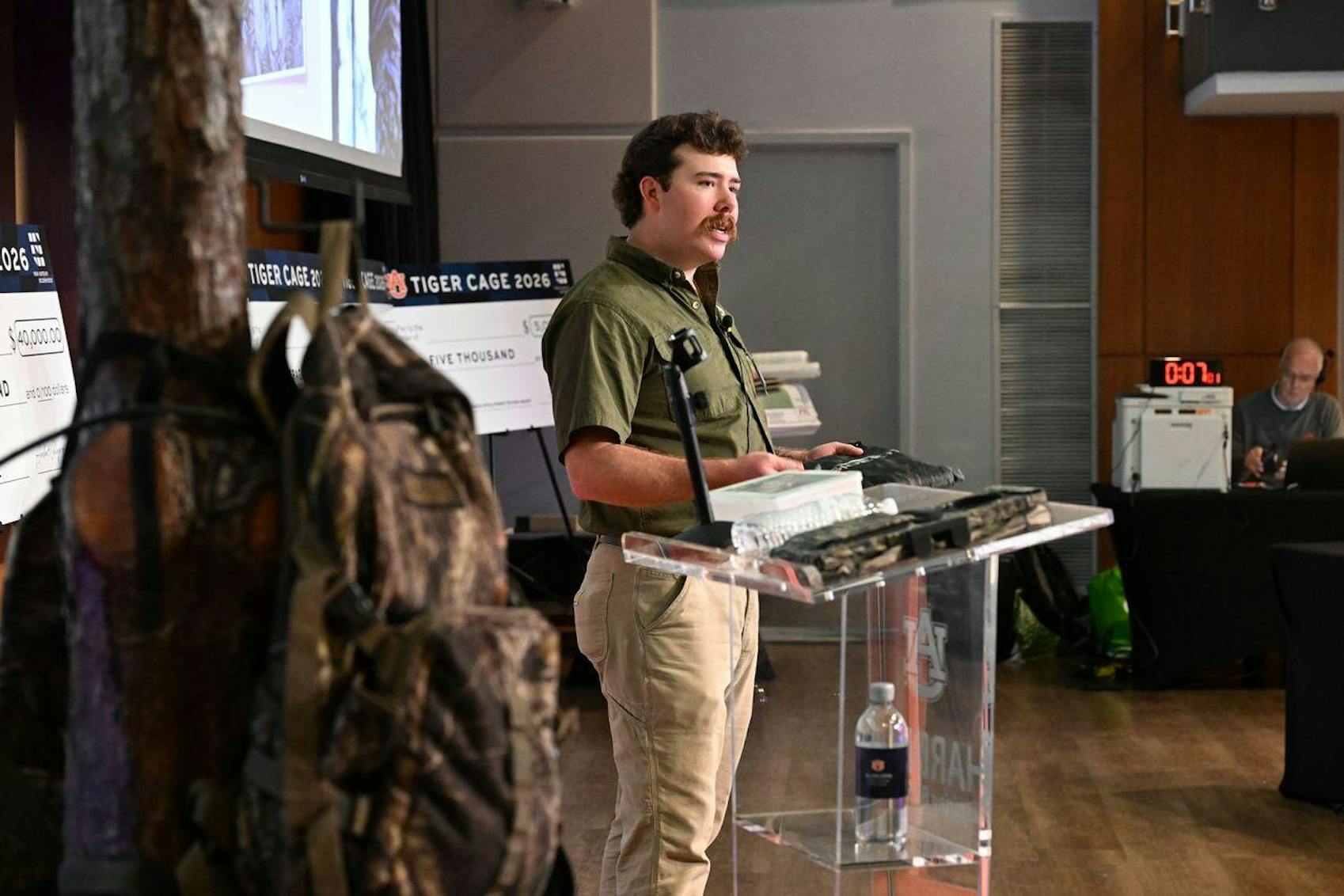
Founder and avid bow hunter Bass Ninas pitches his hunting gear organizer Side Kit at the Tiger Cage Semifinals. Contributed by Auburn University's New Venture Accelerator media and marketing team.
Side Kit is a lightweight and collapsible tree-stand organizer for hunters that keeps gear secure, organized and accessible. This outdoor innovation simplifies hunting, primarily functioning to hold all necessary equipment, so individuals can eliminate the incessantly irritating act of fumbling through their bags and pockets.
Founder, avid bow hunter and senior in business administration, Bass Ninas found himself interviewing “anyone and everyone” outside outdoor stores about this annoyance, discovering a desire in the market for a kit.
“I saw the problem my whole life," Ninas said. “There are options but none are functional; none allow easy access to the things you need within arm's reach. I believe potential customers will switch since this option is affordable, convenient and functional.”
Being early in the business process, Side Kit has finalized the first field tested prototype with roughly six custom camouflage patterns, which are currently available on their website in pre-sale. Eventually, Side Kit will sell direct-to-consumer e-commerce, through trade shows and then scale through selling in big box, outdoor stores.
5. Sophie Sweets
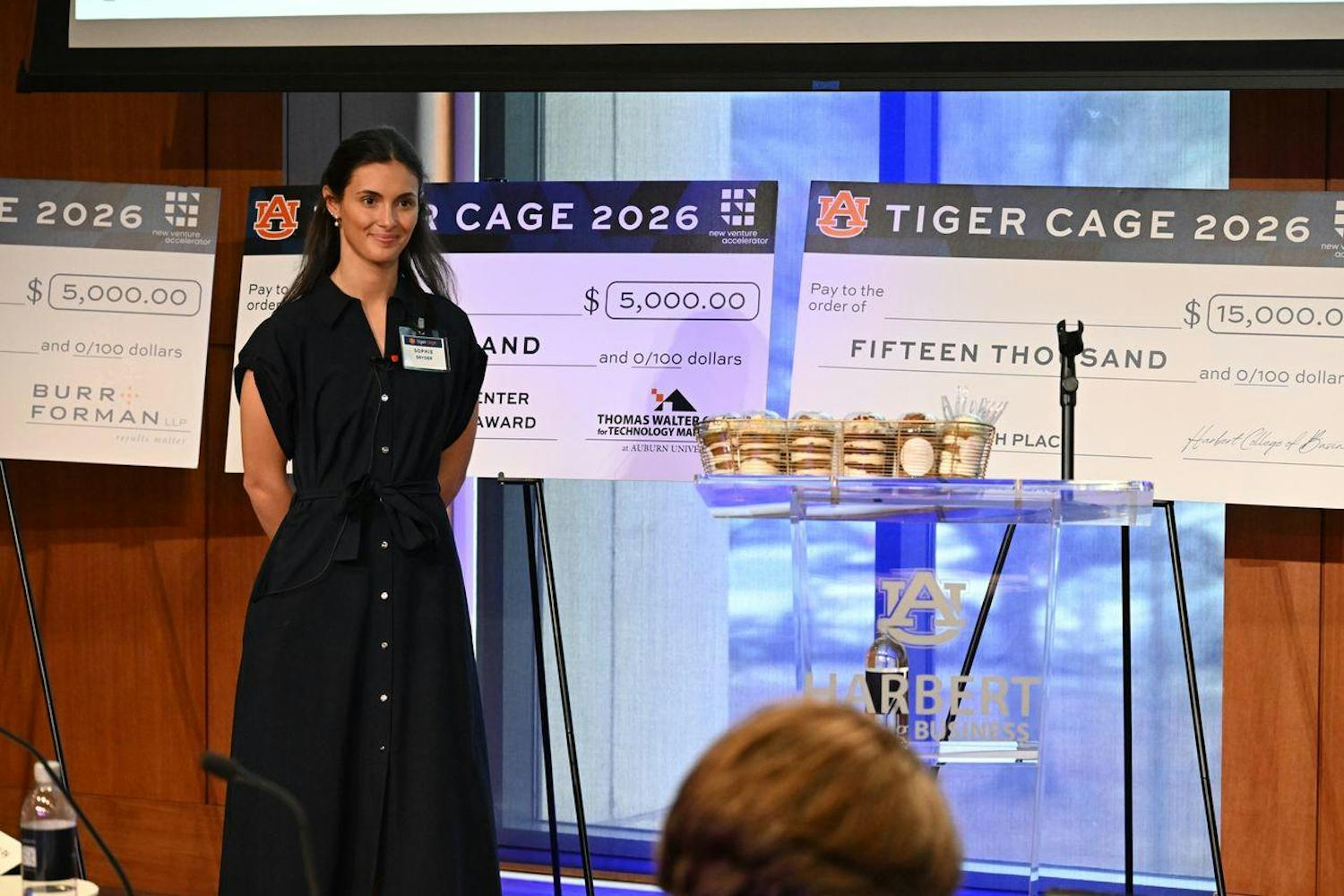
Founder Sophie Snyder pitches her student-run cake and bakery business Sophie Sweets at the Tiger Cage Semifinals. Contributed by Auburn University's New Venture Accelerator media and marketing team.
Sophie Sweets is a student-run bakery located within Hey Day, offering trendy and gourmet cakes and cake cups made from scratch. Whether it's ordering a dozen cupcakes or a large celebratory cake, Sophie Sweets focuses on matching quality with convenience – baking fresh and delicious desserts ready within short periods of time, as early as next-day pick up.
Founder Sophie Snyder, senior in hospitality management with a focus in culinary science, grew up in Auburn baking cakes, leading to a successful local wedding cake business. She quickly realized a demand in the market for selling quality desserts that did not require weeks in advance to order.
“As someone who tends to be last-minute, I didn’t enjoy settling for grocery store cakes that lacked quality and creativity,” Snyder said. “I saw an opportunity to create a business that delivers gourmet, trendy cakes quickly without sacrificing taste or design.”
Only being in business for 10 weeks, Sophie Sweets has generated nearly $40,000 in revenue in cake cups alone in-store and through online ordering and pickup. If the business continues to have strong sales and frequent sell-outs of products, Sophie Sweets plans to grow by continuing to partner with campus organizations and take advantage of wholesale opportunities.
Do you like this story? The Plainsman doesn't accept money from tuition or student fees, and we don't charge a subscription fee. But you can donate to support The Plainsman.