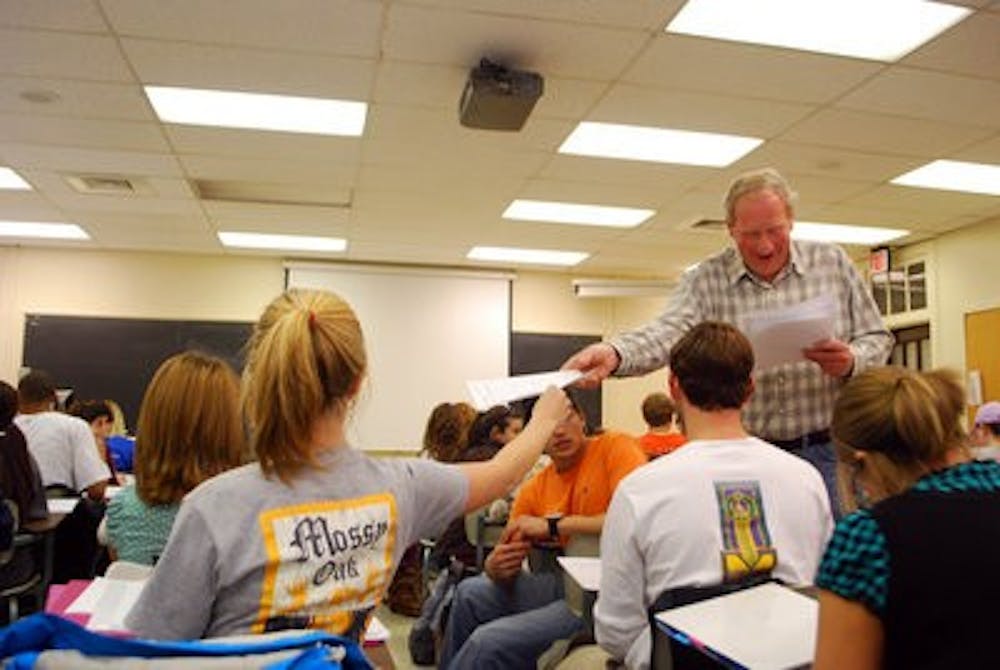
Daryl Kuhlers' Animal Breeding class combines genetics and statistics to examine the genetic improvement of animals through breeding.
"When people hear the term 'animal breeding,' they think it has something to do with reproduction, and it's really not," Kuhlers said. "What we're trying to do is estimate the breeding value, so there's a little confusion when I tell them on the first day we're not going to talk about hormones or reproductive anatomy."
Breeding value is measured by the quality of offspring an animal produces and considers certain factors such as an animal's muscling, overall health and ability to produce quality products for consumption, be it eggs, milk or meat.
Genetic improvement aims to strengthen these factors through a selective breeding process over time.
The class does not focus on a specific breed of animal, but instead examines whole populations or groups of animals.
"What we're trying to do is say, 'Here's how we make genetic improvement for what we want the animal to do,'" Kuhlers said. "Typically we want our animals to grow faster.
"For dairy cows we want them to produce more milk, and we want them to eat less feed so we can make more money. Our goal is to see how we can make these animals more productive at a lower cost."
The class spends most of its time learning formulas and equations that help predict the productivity of breeding.
"I teach the principles and that they work for everything," Kuhlers said. "You may have to do some adjustments for the specific life cycle of the animal, but it works for anything."
Students find the heavy use of math and rigorous amount of work the most challenging aspects of the class, Kuhlers said.
Leslie Bowman, senior in animal science, said even though the class is assigned a large amount of reading, most of the quiz answers are numbers instead of words.
"It's a lot of equations--it's genetics and statistics put together," Bowman said.
The class is assigned homework, reading quizzes and discussion questions weekly and is evaluated through these assignments in addition to exams.
"The students do like the discussions and the chance to interact," Kuhlers said. "I tell them, 'It's time to meet your neighbor.'"
Elizabeth Ortiz, senior pursuing her second degree in animal science and pre-veterinary medicine, said the class has opened her eyes to how much statistics plays a roll in breeding.
"The class is basically about choosing the best out of your herd that you have to make genetic progress," Ortiz said.
She said the class deals exclusively with livestock, although it is possible to apply the principles to other domestic animals.
However, wild animals are not studied in breeding because they use their own form of mate selection.
Kuhlers said one aspect of the class that has evolved during the years is many students now are unfamiliar with farms and animals because they come from cities.
"Students' background is a little different now, so to some extent I spend time explaining why this stuff is important on a farm because they don't have a feel for that," Kuhlers said. "If they're not on a farm they don't really know."
Kuhlers said it is important to remember when breeding animals, the animal must have a specific goal or purpose, whether they are horses, dogs, fish or honey bees.
There is no reason to worry about the productivity of animals intended for pleasure, such as pets or animals that the breeder does not intend to sell for profit.
The purpose of an animal is whatever the breeder's goal for the animal may be, whether it is selling that animal for food or competing the animal in shows or races.
Currently the class is studying breeding predictions.
The class is required for animal science majors, but it is open to all students.
According to Kuhlers, he also has agriculture education, biological sciences and several other majors in the class.
However, he said a strong background in math--specifically statistics--is recommended for the class.
Kuhlers has taught the animal breeding class for 33 years.
Do you like this story? The Plainsman doesn't accept money from tuition or student fees, and we don't charge a subscription fee. But you can donate to support The Plainsman.