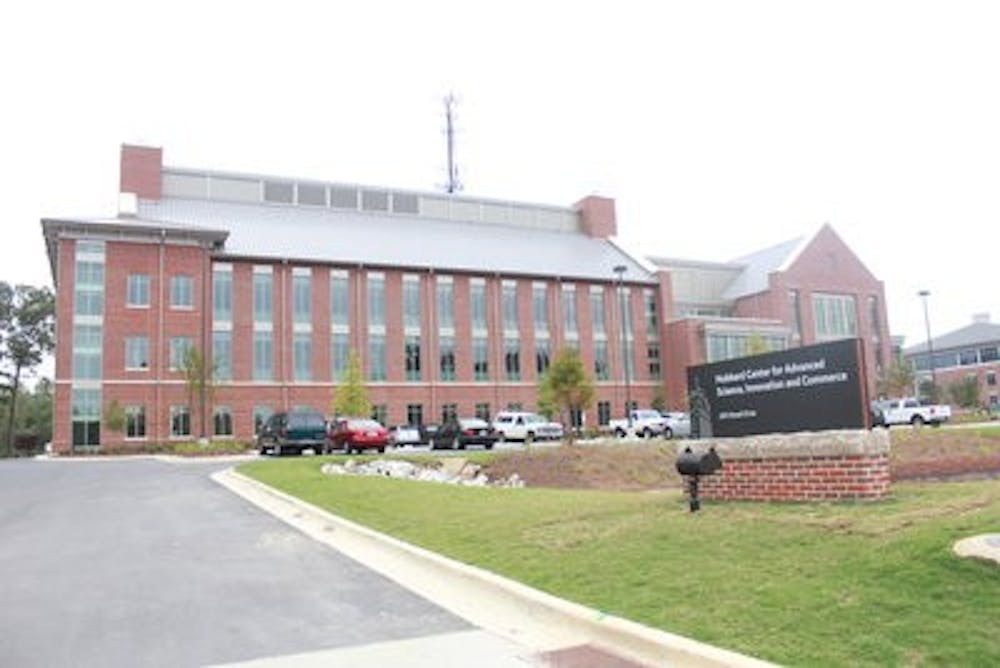
The Mike Hubbard Center for Advanced Science, Innovation and Commerce, or CASIC, officially opened after a ceremonial ribbon cutting Wednesday, Sept. 12.
"It's a world-class facility," said Josh Woods, director of communication and marketing for the College of Agriculture.
William Batchelor, dean of the College of Agriculture and director of the Alabama Agricultural Experiment Station (AAES) said amenities in the new facility included 20 laboratories, conference rooms, two five-ton cranes and the most powerful computer in Alabama.
CASIC will be interdisciplinary and will be used by the Colleges and Schools of Design and Construction, Engineering, Architecture, Sciences and Mathematics and Forestry and Wildlife Sciences.
"The building was built for collaboration," Batchelor said. "All our programs are multi-college programs."
Batchelor and Woods said CASIC will serve dual purposes as both a research center and as an outreach tool.
"It's going to be crucial to finding the discoveries that will carry us into the future," Woods said.
Research pertaining to genomics, irrigation and renewable energy will be conducted in the center.
"Ten years down the road, there will be a renewable energy program in the state of Alabama due to these programs," Batchelor said.
The renewable energy research involves converting biomass pine trees, into an energy source.
"We've (developed) the tech to do that, but we do it on a very small scale," Batchelor said. "We want to do it on a much larger scale."
Batchelor said every program leads to products, which lead to commerce.
He cited the irrigation aspect of water-resource research as an example of the potential commercial impact of CASIC.
Batchlor said it's possible the research could increase the amount of corn grown in Alabama.
"Half of a million acres of corn would have the same impact as adding an auto manufacturer," Batchelor said.
However, $28.8 million had to be spent before CASIC could begin earning money in the forms of grants and research aid.
The facility was first proposed in 2008 and was funded by a $14.5 million grant from the U.S. Department of Commerce's National Institute of Standards and Technology, in addition to $14.1 million in state funds.
The remaining $200,000 needed to build CASIC was contributed by Auburn University.
Some of the money also came from the Alabama Agricultural Experiment Station.
Woods said Hubbard, speaker of the Alabama House of Representatives, was instrumental in securing the state money essential to CASIC's construction.
"Hubbard was critical to the success," Woods said.
Construction of CASIC began in 2010, two years after the proposal.
"It moved fast," Batchelor said. "We had great contractors."
Batchelor and Woods said they praised the finished product.
"It's a very good work environment," Batchelor said.
Woods said he found it exciting to have the opportunity to work in the new building.
Do you like this story? The Plainsman doesn't accept money from tuition or student fees, and we don't charge a subscription fee. But you can donate to support The Plainsman.