Lately, my social media algorithm has been circling back to Sylvia Plath’s “The Bell Jar,” specifically her famous poem “The Fig Tree." In the poem, Plath expands upon the seemingly endless choices in life — and how, with each decision, your path becomes more focused and equally more limited.
As a lover of literature and poetry, I happily liked most — if not, all — of the posts my algorithm placed before me, but to be honest, I did not remember the poem that well. The last time I read it was in high school, and after my third recommended post — feeling like I was on the outside of an inside joke — I stubbornly reread it.
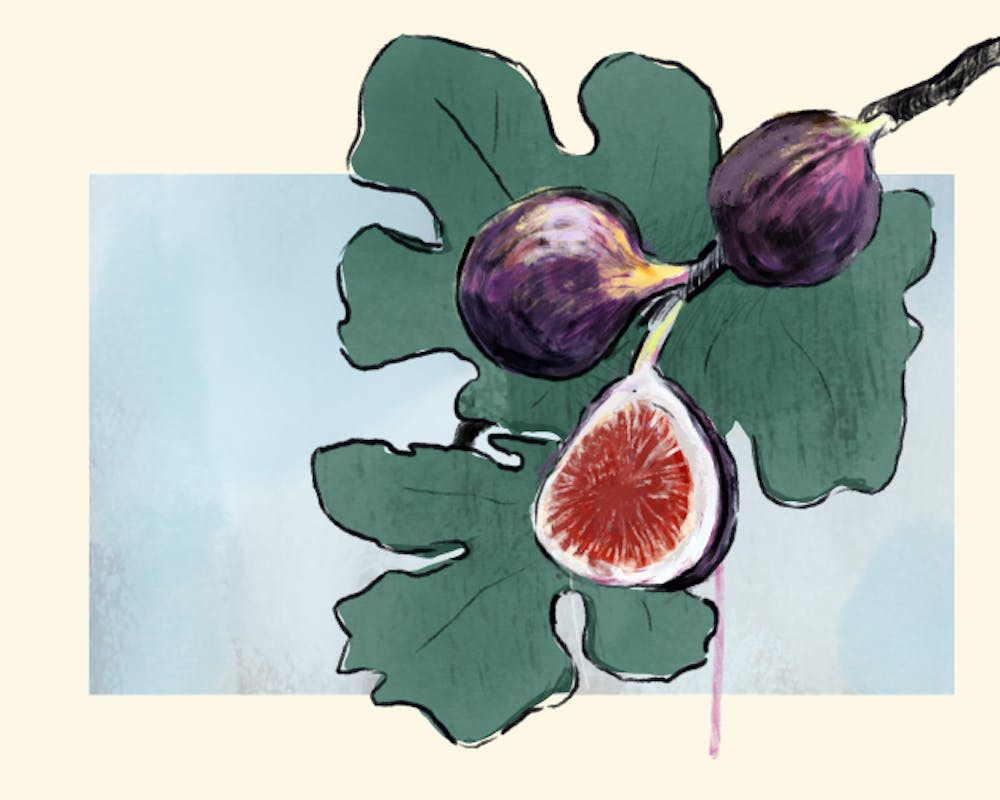
I saw my life branching out before me like the green fig tree in the story. From the tip of every branch, like a fat purple fig, a wonderful future beckoned and winked.
For those who have not read it – although I highly recommend you do — Plath opens “The Fig Tree” with the simple line, “I saw my life branching out before me,” comparing her life to a fig tree. She goes on to depict the potential paths her life could take as fat, purple figs dangling from the branches that “beckon and wink” futures at her.
In the poem, each fig represents a radiant yet exceedingly different life: a happy home with a husband and children, a famous poet, an adventurer of continents, a pack of lovers or even an Olympic lady crew champion.
Some figs even stretch far beyond what Plath’s naked eye can see or what her mind can comprehend from her position at the bottom of the tree. The figs are simply far too many to choose just one.
However, as the poem continues and Plath stays below the tree, lamenting her inevitable decision to pick only one and seemingly lose the rest, the figs of the tree begin to fall one after the other – and with them, the life they represent.
I saw myself sitting in the crotch of this fig tree, starving to death, just because I couldn't make up my mind which of the figs I would choose.
This comes to both Plath's and the reader's surprise, as Plath describes herself as “starving to death,” while the figs wrinkle and go black at her feet.
I wanted each and every one of them, but choosing one meant losing all the rest, and, as I sat there, unable to decide, the figs began to wrinkle and go black, and, one by one, they plopped to the ground at my feet.
As I refreshed my memory of this poem, my chest twisted with a feeling of true empathy. The weight of decisions — even those of the smallest degree — has followed me long before I can remember, and this poem’s ability to truly capture this feeling took my breath away.
In the following days, my algorithm continued to feed me videos about the poem, and after my memory refresher, what I found most interesting was other viewers’ vastly different reactions to it. Even more interestingly, the viewers themselves were as wide-ranging as their responses.
Surgeons, engineers, graphic designers, firefighters, nurses, housewives and social media influencers all proudly reviewed the poem in the comments, with responses ranging from bitterness and anger to love and gratefulness.
However, regardless of their reaction, they all — like me — seemed to relate to Plath’s dilemma, whether they realized or not.
Yet, the most surprising and unifying reaction was about the poem’s reflection on indecision. Several commenters protested the end of the poem, complaining it was “impossible” to choose just one fig in their own life. The fact that Plath stood beneath the tree until the figs rotted seemed reasonable, almost as inevitable as the figs themselves rotting.
While I would like to say otherwise, this feeling is not farfetched or even odd. In fact, it is embarrassingly mutual.
My initial reaction at the end of the poem was virtually the same. How can one choose a single life, knowing that they lose almost all others in the process?
Simple answer: Because if you do not choose, you lose all anyway.
Of course, this resolution is frustratingly “easy” and one that Plath illustrates so well.
This semester, I stand on the precipice of some of life’s most important decisions: planning a wedding, applying to law school and choosing what I want to do and who I want to be when I leave the Loveliest Village of the Plains.
These changes are beyond exciting, but with change comes a certain level of fear. How do I know if I am making the right decision with planning? How do I know if I will attend the right school? How do I know if I will end up in a good spot after leaving the university I have called home for two years?
Another simple answer: I don’t know — and I will not until I make the decision.
That is the ironic part about life: Hindsight is 20/20. It is truly a pain when you want to make the right choice and are only equipped with your “best guess” at what will make you happy, with your current emotions, experiences and education. After all, your immediate knowledge is limited. You have so much life left to live, and each decision only narrows down that path.
However, that is the beautiful part of life: You get to make those decisions and see where you end up.
Yes, life is finite, but perhaps, its finiteness makes it worthwhile and exciting. We only have one life to live, and this fact makes our choices even more meaningful. We must sacrifice to discover what truly matters to us, but that only gives our choices more weight, more purpose.
We get the opportunity to choose, and even if we choose “wrong” — whatever that means — we can go back and try again. Obviously, this will not be done without some heartbreak, growing pain or even loss, but the simple fact that you are moving forward is an accomplishment.
The worst step you can take is no step. Failure is not retrying but instead inaction, as Plath unfortunately does in the poem. Of course, her actions are understandable and even relatable, but they serve as a warning.
If you do not let some figs rot, they all will. In other words, in not deciding, you ultimately decide.
So you may not be able to eat every fig on the tree of your life. In fact, it is impossible to eat every fig, but that is the point.
Choices have effects and narrow your path in life, but with that narrowing comes focus. You get to prioritize what truly matters, so as you think about the poem and about next year, next month or even just tomorrow, I hope that you make those choices, even if you feel lost or unequipped to make the decision.
Your future self will thank you if you let some figs rot.
Do you like this story? The Plainsman doesn't accept money from tuition or student fees, and we don't charge a subscription fee. But you can donate to support The Plainsman.
Ally Northridge was with The Auburn Plainsman from fall 2024 to spring 2026 when she graduated with her Bachelor of Arts in Political Science. Northridge served as a news writer, a news reporter, and the managing content editor.