If anyone paid close attention to the Winter Olympics this year, they’d know the drama and news have been plentiful. My favorite moments included Sturla Holm Lægreid, after winning bronze in 20km biathlon, openly admitting to cheating on his girlfriend, and the absolute scene of the men’s Canadian and Swedish curling game.
We’ve also seen incredible stories that have inspired us, like the internet-beloved Jamaican bobsled team and Alyssa Liu's gold medal for the U.S.A. women’s figure skating team, the first since 2002.
Overall, this Winter Olympics has kept us more than entertained and proud of these Olympians.
However, amid these humorous incidents and competitive fun, something more serious was going on in men’s skeleton.
For context, the sport itself is considered one of the more dangerous events, with competitors flying down a track on a sled, face forward, in only a helmet and body suit at over 80 mph. The environment of the race is noticeably intense. However, this year's attention came before a racer even touched the track.
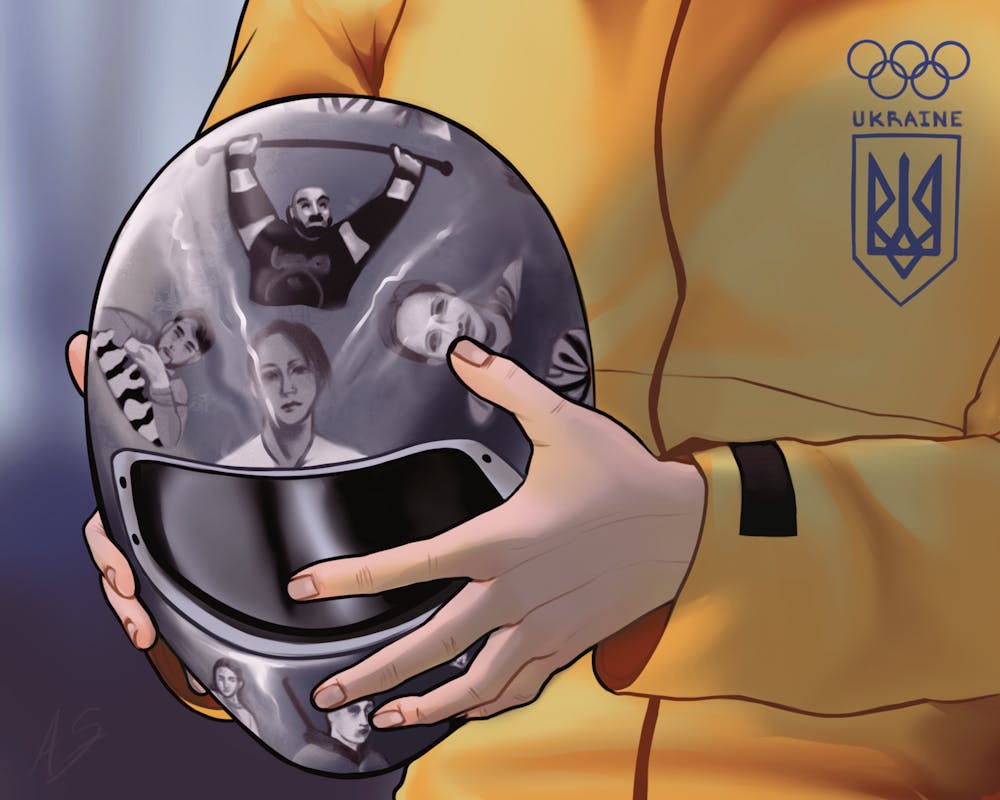
Vladyslav Heraskevych of the Ukrainian skeleton team was disqualified after attempting to race in a helmet honoring 24 Ukrainian athletes and citizens who died from the war with Russia.
In 2022, Russia began its invasion of Ukraine, but the conflict started even before that, with attacks on Crimea since 2014. This conflict has been long and brutal, but the world almost unanimously stands with Ukraine. The U.S. even refused to recognize Russia’s annexation of Crimea and provided aid to Ukraine, although people continue to urge for further support of the Ukrainian cause.
Retaliation against Russia’s actions includes not only global support for Ukraine but also a ban from the Olympics. The Olympic suspension of Russia took effect in 2023 after it competed at the 2022 Beijing Games. The International Olympic Committee (IOC) stated that Russia’s actions were a direct violation of the Olympic Charter. However, Russia is currently permitted to return to this year's Paralympics.
Even with these considerations, people call out the hypocrisy of the IOC regarding its decision not to ban other countries for similar behavior. These comments specifically focus on Israel, with critics arguing it violated the rules of the charter. The IOC’s only response to this criticism was that competitors weren’t allowed to comment support on the ongoing attack against Gaza but enforcement of that has been arguably loose.
Understanding that the IOC bans countries for their involvement in and creation of warfare and conflicts, it can be understood that Russia is facing a global punishment for its actions towards Ukraine. Taking a look at prior bans by the IOC against countries, we see prime examples of global disapproval. Major examples are Germany’s bans from the 1920, 1924 and 1948 Olympics for their role in the World Wars and South Africa’s ban from 1964 until 1992 for their apartheid policies. Overall, it’s clear that to be banned from the Olympics is not a simple feat.
So, it’s interesting that even with the IOC’s implied condemnation of Russia’s actions toward Ukraine, it reacted so harshly to a Ukrainian athlete's wish to honor athletes and citizens who had died in the conflict.
Heraskevyc named the helmet a “helmet of remembrance” rather than the alleged political speech that the Olympics saw it as. Rule 50.2, which the IOC cited in the decision of the Olympic Charter, states that “no kind of demonstration or political, religious or racial propaganda is permitted in any Olympic sites, venues or other areas.”
The significant issue with this ruling is that the Olympics in the past have permitted peaceful speech. This even included a previous action by Heraskevych, in which he held a sign reading “No war in Ukraine” at the 2022 Beijing Winter Olympics after his run. Heraskevyc faced no repercussions for this sign from the IOC.
What made the helmet different?
The honest answer: not much. The IOC argues that they allow athletes to voice opinions away from the playing space, such as in interviews, and that they provided Heraskevyc with other options for support, such as a black armband. Nonetheless, Heraskevyc didn’t even consider his helmet a political statement, arguing he was just honoring deceased friends and teammates.
It’s also of note that helmets in skeleton are usually the most intricate and pronounced piece of the uniform of athletes. The helmet of the athlete is what’s shown as the athlete comes down the course, only sometimes panning to their bodies. Therefore, many athletes have colors and symbols that might express their country, interests or culture. It’s not uncommon to see these athletes putting images or designs on the helmet. So the images on the helmet wasn’t the issue; it was that the dead depicted were from an ongoing war.
Can we consider the remembrance of the dead as political speech?
Even if you are on the side that does, no one can pretend that the Olympics have never been political.
At face value, we can pretend that the Olympics are purely sports and watching the best athletes in the world compete for their country, but that’s simply untrue.
The Olympics have always been a playground for groundbreaking moments and statements to be made. This year, the U.S. team faced many political confrontations by the media and addressed the world with their opinions on these. Famously, Hunter Hess, a freestyle skier, answered a question on immigration by saying that holding the flag didn’t mean he supported the current actions of the U.S., which President Trump swiftly criticized. Undeniably, the Olympics provide platforms to athletes to voice their concerns and opinions, so we can’t be upset when that happens.
The Olympics have historically been involved in global politics. For example, in 1908, Ireland publicly protested and boycotted the 1908 London Olympics after not being allowed to enter separately from the United Kingdom. Irish athletes competed under other countries, including the United States of America, so that they wouldn’t win medals for England, allowing a strong message of Irish nationalism to be spread through each medal won.
There is also the more infamous example of Jesse Owens competing and winning gold in the 1936 Berlin Olympics. Jesse Owens, born in Oakville, Alabama, notoriously dominated his races in Nazi Germany, breaking barriers globally and back home in America, which was still segregated. Owen's accomplishments discredited Hitler's ideology and arguments for racial supremacy and highlighted the hypocrisy of Americans' own racism. Clearly, the Olympics have been political for at least a century, if not since their creation.
In practice, even an athlete's existence in the Olympics is political. While it shouldn’t be an athlete's duty to remedy foreign conflicts, the ideas they represent and their accomplishments are demonstrated to the world. We watch these athletes as individuals and as extensions of their country.
Going back to Heraskevyc’s story, we can then see how the harshness of IOC’s reaction came as a bit of a surprise. The Ukrainian President, Zelenskyy, and other Ukrainian athletes are similarly arguing that Heraskevyc's action of remembrance shouldn’t have been considered a violation.
Heraskevyc pointed out that another skeleton racer, Jared Firestone of Israel, posted a video saying he’d wear a kippah in remembrance of Olympians killed in West Germany in 1972. However, unlike Heraskevyc, Firestone did not receive any criticism from the IOC for his remembrance during the competition.
Although we are holding conversations about political speech, I will remind you again that Heraskevyc didn’t intend the helmet to be, at least, directly political. Those that he put on the helmet are those who died because of the war, but Heraskevyc argues he was only honoring their memories.
The IOC has a tricky job of not only trying to accommodate 93 countries that compete in the Winter Olympics but also simultaneously attempting to prevent any problems from overflowing into the games. They try to address situations in case-by-case analysis, which allows for a somewhat non-uniform application of the rules. Some cases are ultimately more scrutinized than others. Perhaps this helmet will mark a stricter reading of rules by the IOC in the future, but as of these games, we didn’t see that change.
I respect the IOC's neutrality but question the ways they decide to apply it.
This helmet is currently, and will most likely remain, the most controversial piece of the Milan-Cortina 2026 Winter Olympics, especially considering that Heraskevyc was not only Ukraine’s flag bearer but also an expected medalist at this year's games.
Even with the attention on Vladyslav Heraskevych this year not coming from a gold medal, his message lives past the competition. The Helmet of Remembrance passes on, and it is now our duty to face the memory he shares.
Do you like this story? The Plainsman doesn't accept money from tuition or student fees, and we don't charge a subscription fee. But you can donate to support The Plainsman.