It is rare to find any student, professor or administrator who can confidently recollect every building on Auburn's sprawling campus. While most are familiar with the Haley Center and Melton Student Center or have fond memories at Jordan-Hare Stadium and Neville Arena, some buildings at Auburn remain far more unacknowledged than others. After campus's long, substantial history, many buildings have simply been left nearly forgotten.
Old Main Hall
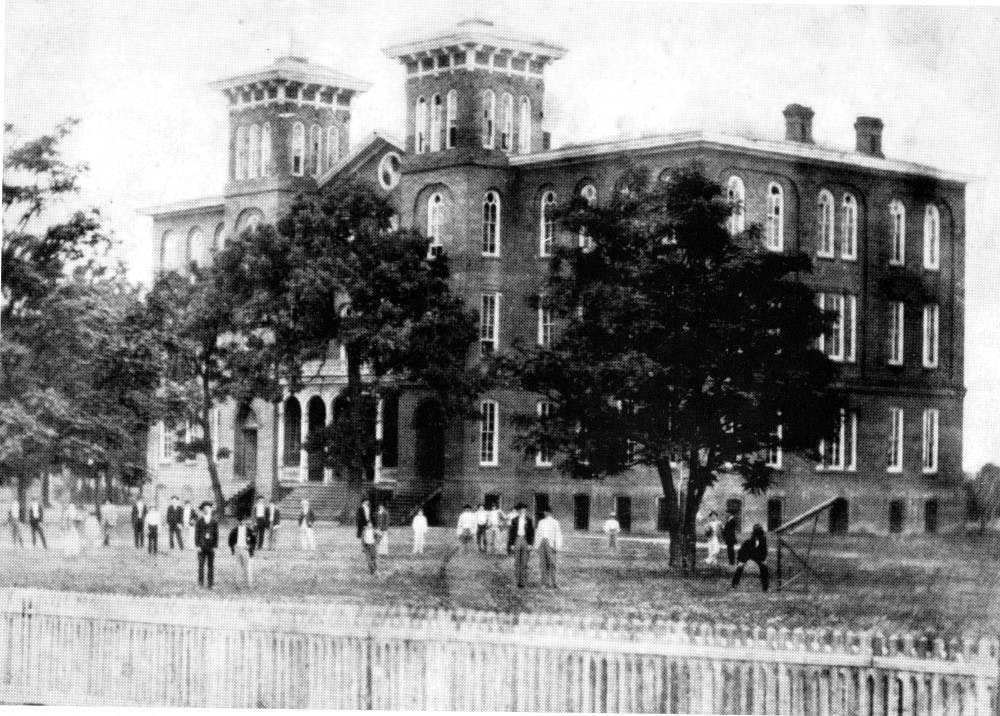
The iconic Samford Hall clock tower seems to have always been a fixture at Auburn, but many students may not know that it is actually a replacement for another building that used to stand in the same spot: Old Main, the first building on Auburn's campus. Less familiar, however, is the history of that original building.
Old Main Hall, completed in 1859, was a four-story, symmetrical brick building where some of the earliest classes at Auburn were held. The building accommodated six faculty members who taught the then-80-person student body. During the American Civil War, Old Main served as a hospital for Confederate veterans, as the university was closed for the duration of the war. In 1887, the same year the Hatch Act was passed, allowing Auburn to purchase more land for expansion, the building was destroyed by a fire. Samford Hall would be built on the same site as Old Main Hall, incorporating the ruins of the destroyed building into its design.
Graves Center and Cottage
During the 1930s, Auburn University, then known as the Alabama Polytechnic Institute, looked to expand its agricultural program, specifically to provide on-campus housing for agriculturalists visiting for conventions. This led to the construction of the Graves Center, a complex consisting of 30 small cottages, an amphitheatre and a dining hall.
The complex, located just south of the modern ACLC building, was built in the Greek revival style and would be repurposed several times over the ensuing decades. The Graves Center even temporarily housed the Auburn University football team in the late 1940s. As time passed, much of the complex was relocated or demolished to make space for other campus buildings. The Graves Cottage, the last of the existing buildings, still stands, hidden away on Auburn’s campus, and the amphitheatre lies just outside Dudley Hall.
Boiler Houses
From the 1920s to 1940s, Auburn experienced rapid campus growth, with many campus dormitories and classroom buildings built over the two decades. During the Second World War, Auburn University also hosted a number of military training programs. These events combined to put a heavy demand for electric power in Auburn, resulting in a number of boiler units and steam plants being built on campus.
While many of these were later removed as demand subsided, some boiler houses remained, heavily modified to serve as steam distribution hubs and chilled-water plants in the modern day. These buildings, essential for Auburn’s transition into a modern university, lie hidden away from sight; some can be found near Broun Hall, as well as south of campus, nestled within the agricultural research areas.
Auburn Sports Arena
Opened in 1946, the Auburn Sports Arena, nicknamed “The Barn” by students, served as home to the Auburn University basketball team until 1968. Located just south of Jordan-Hare Stadium, the venue would continue to host Auburn’s women’s gymnastics team, as well as other student events.
On Sept. 21, 1996, during a home football game against LSU, fans noticed a large plume of black smoke emanating from just outside the stadium. As investigations would later reveal, the embers of a grill at a nearby tailgate likely started a fire that quickly enveloped and ultimately destroyed the Auburn Sports Arena. The venue was be completely demolished following these events. Today, the former site of the arena has now been repurposed as a parking deck.
Beard-Eaves Memorial Coliseum
Following its opening in 1968, the Beard-Eaves Memorial Coliseum replaced the Auburn Sports Arena in hosting basketball games and still stands on campus today, just south of the Auburn Recreational Center. However, since the opening of Neville Arena in 2010, the coliseum sees far less usage in the present day.
For many Auburn students, the oval-shaped concrete building stands as a relic of the past, although the coliseum has not been completely disregarded. Originally planned for demolition in the early 2010s, the stadium has since been used as a concert venue, a COVID-19 testing facility and a site for student and Greek life events. The future remains uncertain for the Beard-Eaves Memorial Coliseum, as demolition, renovations and expansions all remain options.
Abundant with student life, academics and sporting events, Auburn’s campus has always touted a unique history as sprawling as the university itself. However, some of Auburn’s most historic buildings lie hidden away on campus or in historical records, once celebrated and now overlooked. Even in their antiquity, their stories remain, waiting to be told.
Do you like this story? The Plainsman doesn't accept money from tuition or student fees, and we don't charge a subscription fee. But you can donate to support The Plainsman.