Music is an important part of the human experience and an outlet for expression, but it can be inaccessible to people with disabilities. Nancy Barry, professor and program coordinator of music education, established BraveHeart Music Outreach to provide music education for students with disabilities. Through the BraveHeart Center for Place and Purpose (BCPP), Barry is helping students explore the joy of music.
Barry has been a music teacher nearly her entire life, starting in high school when her own music teacher would give her beginner students to teach. Working with these students, she learned that she could combine both of her shared interests: teaching and music.
As a music education professor, she felt as if it was an important skill to be able to teach music to any and all populations, regardless of disability. This prompted her to start looking for experience opportunities for her students, eventually stumbling upon the BCPP. She spoke with Angela Powell, director of the BCPP, who readily agreed to allow Barry to start a music program.
“I absolutely fell in love with the young adults in the Braveheart Center. They’re people with such heart and such joy," Barry said. “This is a population that probably couldn’t be in a typical high school music ensemble. So, for pretty much all of them, this is the first time they’ve been actively engaged in a music class.”
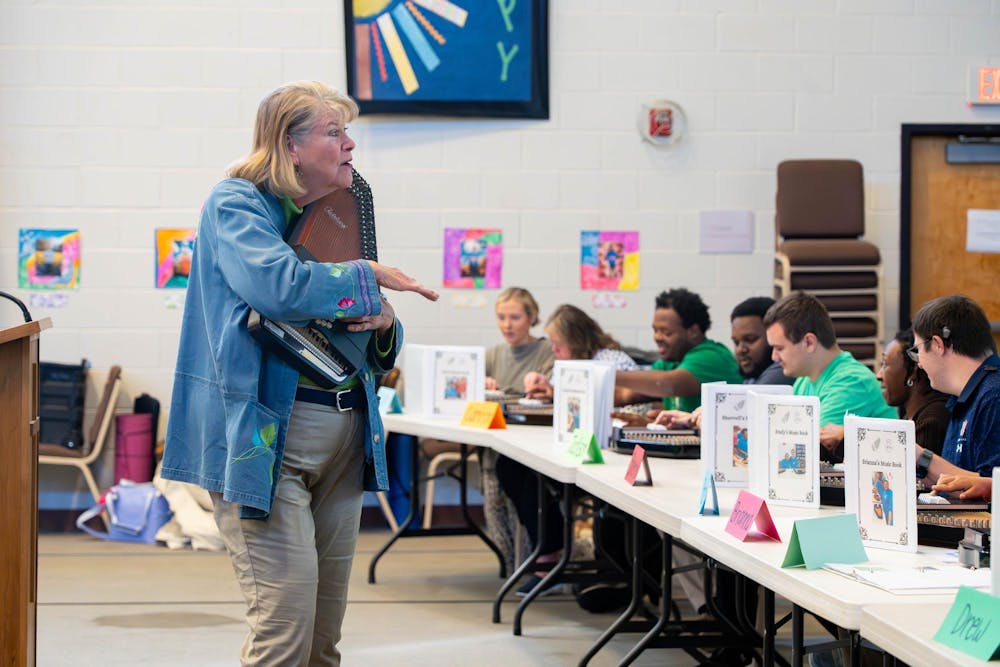
Started in 2024, the class continues to be available every semester, meeting once or twice weekly. Students in the class utilize an instrument called an autoharp, made famous by 1940s country singer Maybelle Carter and then used by many country artists in the coming years. The autoharp was chosen for this purpose because of its accessible nature, allowing for all students to participate.
“If you push the button for the C cord, the rods come down, the felts press down and dampen all the strings, except the the notes of the C chord,” Barry said, “So rather unlike guitar, where you’re having to press the strings to produce the chords, you just push a button.”
Two students would play one autoharp, one person holding down the button while another strummed, and rubber doorstops were used as guitar picks as they are easier to hold than tiny guitar picks for people with dexterity issues. The program continues to adapt to provide the best experience for its students.
The program's repertoire of music consists of about 40 pop and folk songs, each transposed by Barry into C major. Every semester, they introduce 10 new songs for the students to learn.
At the end of the semester, the program's hard work in learning these songs culminates into a concert called an Informance. It's called an Informance because its purpose is to inform the audience about what BCPP does. The last Informance was hosted April 2, centered around the song “I am a Fine Musician.”
The students of the program were very nervous about the Informance, but their minds were soon changed.
“After that first one, they saw how much the audience of friends and family enjoyed them and appreciated them. Their self confidence has grown and grown," Barry said.
Soon, the students were announcing the songs and providing background information using cue cards from the audience. They had grown from just playing and singing along to the instruments, to publicly speaking on the stage. In the most recent concert, students were even able to perform a solo if they wanted to.
Music provides people with a means to express emotion and grow, something that Barry has seen through her work with this program.
“We use music to grieve. We use music to celebrate. We use music to inspire, and special needs populations, people on the autism spectrum, often have trouble expressing emotions,” Barry said. “I work with them about understanding emotions and expressing emotion through songs because that’s one of the things all humans need: music to express emotions.”
Although Barry will be retiring from Auburn University after 30 years of service in the spring, the BraveHeart Music Outreach program will continue, allowing for more individuals with disabilities to experience music education at the highest degree.
Do you like this story? The Plainsman doesn't accept money from tuition or student fees, and we don't charge a subscription fee. But you can donate to support The Plainsman.
Emily Edgy, sophomore in social science and history education, has been with The Auburn Plainsman since Spring 2026. Edgy currently serves as a Lifestyle Writer.