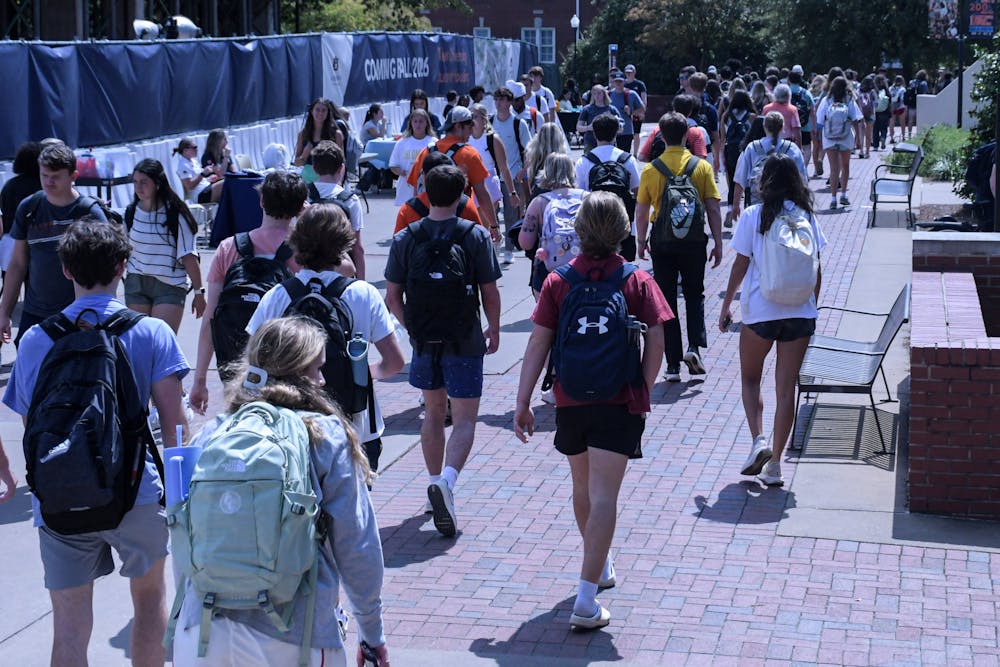
Starting Jan. 7, 2026, Haley Concourse will be a wheels-free zone, according to Student Government Association President Owen Beaverstock. The policy will be in effect from 7:45 a.m. to 4:45 p.m. from Monday to Friday. According to Beaverstock, the new policy will be a pilot project that can change, revoke or even expand across campus depending on effectiveness and student reaction.
The move was fueled by observing other universities’ policies and feedback from students about scooters on campus, including a random SGA survey of 1,000 Auburn students about different campus initiatives.
“Early view from that survey and all the in-person feedback from student groups that we did in our outreach is that there is a negative feeling among the student body towards scooters and other mobility devices on campus,” Beaverstock said. “Within that survey, we saw 78% of that 1,000-person survey in support of a wheels-free zone on campus in a couple different locations, and we also got that from the outreach we did in person.”
The survey in question did not ask students about their feelings regarding other vehicles.

Daytime security officers will enforce the policy through a broader initiative to increase daytime security across Auburn’s campus. Officers will pass out information and signage will be posted. While most enforcement will come down to telling people to dismount their vehicles and walk through, more severe disciplinary action could be taken for “extreme” violations, which were not described.
“We’re also going to be complying with the policy included on the Auburn website,” said Beaverstock. “And in that policy, potential violations could be treated with student conduct issues or parking/transportation violations as a potential possibility.”
Although Beaverstock referred multiple times to the university’s policy on personal electric mobility devices as a basis for the wheels-free zone, the policy only concerns electric vehicles with no mentions of non-electric vehicles.
Mobility aids like wheelchairs will still be allowed on the concourse. However, on the topic of whether those with invisible disabilities like POTS could use any banned vehicles, Beaverstock said that they "may have to find an alternative route if [they] still want [to] ride [their] scooter, but [they] can still travel through if [they] chose to walk."
Beaverstock also presented other options.
“I think we can work something out where we can talk to our daytime security officers, and if that is a situation, then that student can explain it to the officer and shouldn’t be a problem," Beaverstock said.
On the subject of whether SGA anticipated any issues with students having to disclose their disabilities, Beaverstock stated that it is not currently a concern.
“We’ve gone through multiple different university departments, and that has not been a problem that has arose thus far,” Beaverstock said. “If it is a potential problem, or any student feels that it is, I would encourage them to reach out to us and talk to us about it.”
Although the policy’s initial phase still allows golf carts to pass through Haley Concourse, Beaverstock said that they could be included in the policy if they are still a concern.
In the end, Beaverstock stated that student opinion on the new policy was the most important factor.
“We want to hear from students how this works,” Beaverstock said. “If it is not something that they are supportive, then we will change it.
Students with feedback about the new policy can reach out to SGA through sga@auburn.edu, Auburn Answers or by visiting the Student Involvement office on the third floor of Melton Student Center.
Do you like this story? The Plainsman doesn't accept money from tuition or student fees, and we don't charge a subscription fee. But you can donate to support The Plainsman.
Sydney Gallardo, junior in journalism, has been with The Auburn Plainsman since Fall 2025. Gallardo previously served as a News Writer, News Reporter and Assistant News Editor. He is currently serving as the Newsletter Editor.