For over a century, Auburn has hosted some of the most impactful and culturally significant singers and performers in the nation. As the local artistic scene blooms now more than ever, The Plainsman takes a look back at the most notable cultural events from Auburn’s long history with performing arts.
For almost as long as Auburn University has existed, there have been live music performances on campus. In the early 1900s, Auburn hosted many musical acts and orchestras in Langdon Hall, which served as the main performance venue on campus.
One of the earliest known performances of a nationally recognized artist or group in Auburn was the John Philip Sousa Band, a band composed of wind and percussion instruments, with their concert in 1919. The most prominently known artist to perform in Langdon Hall, however, was jazz musician Louis Armstrong, who played at Auburn in 1935, as part of his tour of southern colleges and universities. Nat King Cole also performed in Langdon Hall in 1954. By the 1960s, Langdon ceased to be used as a concert venue.
In 1965, Jordan-Hare Stadium, then known as Cliff Hare Stadium, served as the concert grounds for one of the most influential artists of all time: James Brown. Brown performed for about two and a half hours on Oct. 23, 1965, to an audience of about 5,800. His concert is usually credited as the first musical performance in Jordan-Hare. Brown’s concert was one of the first to take place on campus following the integration of the University in 1964 and serves as an important milestone as Auburn’s first large-scale integrated entertainment event.
Upon the 1969 completion of the Beard-Eaves-Memorial Coliseum, the venue became the primary host to the majority of Auburn’s performance events. The first major live event held at the Coliseum was a concert headlined by the Rolling Stones, which also included Chuck Berry and B.B. King, on Nov. 14, 1969. The event is notorious for the Rolling Stones’ late arrival that was nearly three hours after the planned start time. In the spring of 1970, both Steppenwolf and Neil Diamond performed in the Coliseum on April 23 and May 15 respectively.
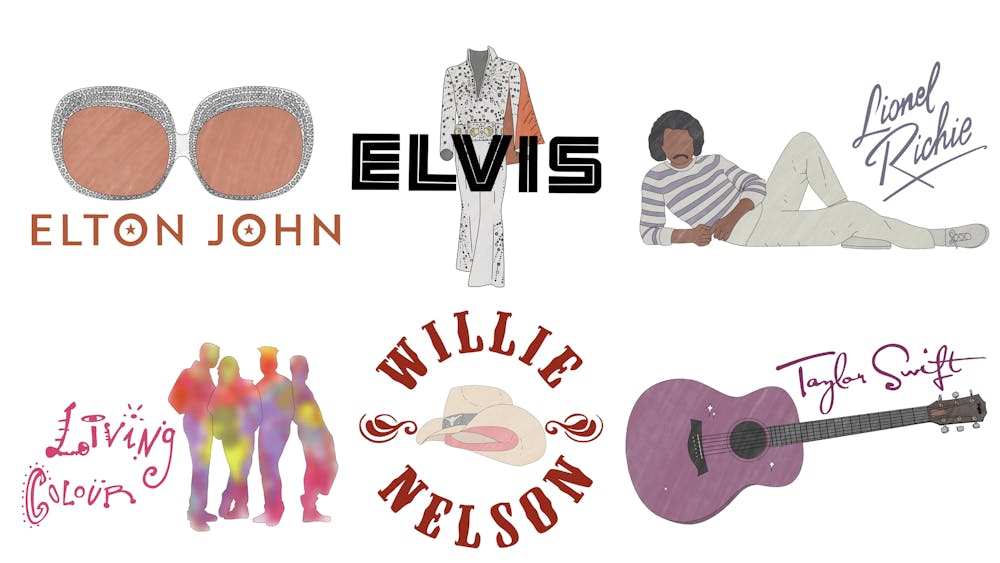
The mid-1970s are regarded as a golden age of artistic performances at Auburn. On Oct. 18, 1973, British musician Elton John performed in the Coliseum on his Goodbye Yellow Brick Road tour. On March 5, 1974, Elvis Presley, one of the most influential and renowned artists of all time, sold out Beard-Eaves on one of his final concert tours. Legendary rock icon Bruce Springsteen performed at the venue as a part of his Chicken Scratch tour on May 11, 1976. Country rock singer Jimmy Buffet performed on April 18, 1979. Buffet also attended Auburn as a student briefly and gave several more performances at the University during the 80s and 90s.
The 1980s also saw no shortage of sensational performances on the Plains. The decade began with a performance from iconic rock band The Eagles on Feb. 1, 1980. Joan Jett and the Black Hearts performed on May 4, 1983. Also in 1983, Lionel Richie performed alongside The Pointer Sisters on Nov. 3. Rock singer Tina Turner took the stage on Nov. 8, 1985, as a part of her Private Dancer tour. The cultural icon Whitney Houston performed on Dec. 1, 1987, during her Moment of Truth world tour.
In 1988, the funk-rock band Living Colour released their best-known single “Cult of Personality,” alongside an accompanying music video. The video features clips of the band performing the song on the Beard-Eaves-Memorial Coliseum stage. The song would later win the Grammy for Best Hard Rock Performance.
The 1990s marked a continuation of cultural relevance and expansion for Auburn. Legendary singer and artist Lenny Kravitz performed at Beard-Eaves on Feb. 11, 1982, alongside the English band The Cult. The Dave Matthews Band took the stage on April 27, 1994. Just two days later, on April 29, Reba McEntire also performed. On March 7, 1997, comedian Jerry Seinfeld performed at the Coliseum, selling out the venue in a record time. Legendary guitarist Willie Nelson concluded the decade with a performance at the Coliseum on May 6, 1999.
Since 2000, Auburn has held a wide variety of performance events with substantial cultural impact. The Beach Boys would perform in Jordan-Hare Stadium on Oct. 19, 2001. The performance marked the first time in decades a concert was held inside Jordan-Hare. Comedian Dave Chappelle performed at Beard-Eaves on Nov. 29, 2006, with a two hour set in front of one of the largest comedy crowds in Auburn history.
Famously, one of the most influential and successful singer-songwriters of all time, Taylor Swift, gave a mini-concert at Auburn on April 26, 2010. Her appearance at Auburn was the culmination of the online campaign "A Hug from Taylor Swift" by a group of university students. Swift performed in a surprise concert at The Hotel at Auburn University and Dixon Conference Center for over 350 students.
More recent performances at Auburn include Ludacris in 2012, Rascal Flatts in 2014, The Neighbourhood in 2017 and Luke Bryan, who regularly performs at Auburn during his annual Farm Tours. Auburn continues to persist as being one of the most culturally relevant places in the Deep South, with over a century of artistic history and plenty more on the horizon. The impact popular culture has had on Auburn is clear, and if there is any lesson to be learned from the history of artistic innovation and expression on the Plains, it's this: Auburn’s long and rich history can’t be told without the arts.
Do you like this story? The Plainsman doesn't accept money from tuition or student fees, and we don't charge a subscription fee. But you can donate to support The Plainsman.