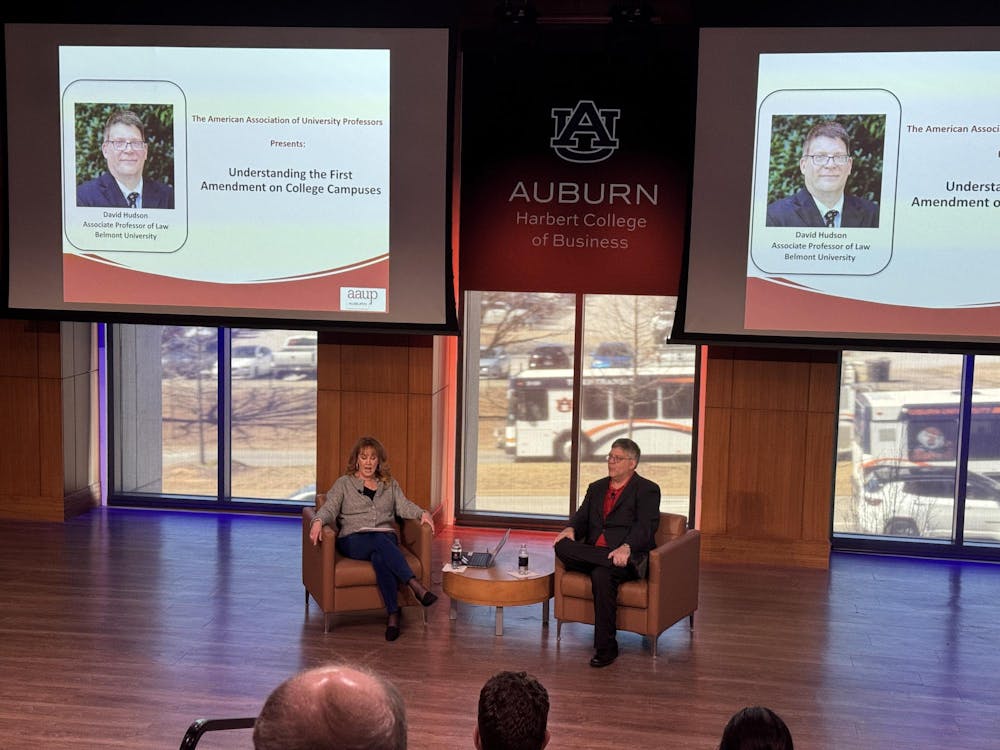
On Feb. 23 at 11 a.m., the American Association of University Professors (AAUP) held a talk titled “Understanding the First Amendment on College Campuses.” David L. Hudson Jr., an associate professor of law at Belmont University, spearheaded the conversation as the event's keynote speaker.
The AAUP, which has an Auburn chapter and other chapters based at colleges and universities across the country, is a nonprofit membership association of faculty and other academic professionals. The organization calls for shared governance among the board, administration, faculty, students and others within institutions of higher education, and it supports students' and teachers’ shared right to academic freedom.
During the event, held in the auditorium on the first floor of Horton Hargrave Hall (HHH), Hudson sat with the president of the AAUP Auburn chapter, Beth Davis-Sramek. He started by defining which types of speech the First Amendment protects and doesn’t protect in America, then transitioned to free speech in higher-ed environments. The audience could submit their questions via Menti, and the event was recorded.
Hudson attended Duke University for his undergraduate degree and received his law degree from Vanderbilt Law School. At Belmont, Hudson teaches Torts, Constitutional Law and First Amendment Law, and he hosts a Bar Exam Workshop. Additionally, he is the author, co-author and co-editor of more than 40 books. He currently serves as a Justice Robert H. Jackson Legal Fellow for the Foundation for Individual Rights and Expression and as a First Amendment Fellow for the Freedom Forum Institute. Furthermore, Hudson was an attorney and scholar at the First Amendment Center in Nashville, Tennessee, for 17 years and has taught classes at the Vanderbilt Law School and the Nashville School of Law.
“The First Amendment really is what Justice Benjamin Cardozo refers to as 'the Matrix,' as the indispensable freedom. If we didn't have any speech, then, essentially, we wouldn't have any other freedom. There are some core foundational free speech principles that are important to understand. I think the first one, perhaps the most fundamental, is that we have the ability to criticize government officials and people in power,” Hudson said. “That's the essence of why we have freedom of speech in the first place. That was a lesson that the United States Supreme Court told us in New York Times Company versus Sullivan, which, essentially, arose out of, in part, Montgomery, Alabama, when the New York Times in March of 1960, published an advertisement called ‘Heed Their Rising Voices.'"
Hudson explained that the second core principle of the First Amendment is that the government cannot restrict speech based on the viewpoint of the speaker, and the third fundamental belief is that the First Amendment allows a great deal of offensive, obnoxious and sometimes repugnant speech. He did note, however, that this type of speech has significantly narrowed over time.
Davis-Sramek, after glancing at the audience's submitted questions on her computer, suggested that higher education is one of the largest forums to practice free speech.
“The U.S. Supreme Court referred to the University as, quote, 'the quintessential marketplace of ideas [and] is supposed to be where we are confronted with all sorts of different viewpoints; points that are challenging and directly against what we might believe,' but it is supposed to be a place where freedom of speech and academic freedom flourish,” Hudson said.
Later in the discussion, Davis-Sramek shifted the talk to the termination of university employees across the country in relation to their freedom of speech. She questioned the impacts of the official statement released by Auburn University President Christopher Roberts on Sept. 17, 2025, announcing the termination of employees because of their statements in relation to the assassination of Charlie Kirk. Davis-Sramek claimed that this announcement worried university employees about what they could post on their personal social media accounts outside the classroom.
“A lot of university presidents did that. I think the problem with it is that a term we use a lot in personal law is showing that, when you have a statement like that from a powerful university official [called the chilling effect], it sends a clear signal to dissuade people from speaking out on issues of public reports and controversy. And that showing, in fact, is troubling from a First Amendment standpoint because the essence [of] the First Amendment is our ability as citizens to speak on matters of public concern, matters of public importance,” Hudson said.
Following this, Hudson and Davis-Sramek went back and forth discussing the implications of the Garcetti case for the protection of government employees. Hudson Jr. then referenced recent Tennessee legislation that limits high school teachers' ability to teach Critical Race Theory.
After nearly an hour of discussion, Davis-Samrek asked Hudson Jr. for one piece of advice for universities navigating the recent developments in First Amendment rights litigation.
“I think they need to really protect the institutional integrity of the university, [which] means a commitment to active freedom of the institution, the active freedom of faculty members and their speech. The students, as well. It's a recognition of the university [to function] truly as a laboratory for free speech,” Hudson said. “It’s a quintessential armchair for ideas. We don't want to engage in any policies or actions [that] threaten or undermine the process and the spirit of reason, discussion and judgment. It's hard because it's a natural human impulse to censor speech that you don’t [agree with].”
Do you like this story? The Plainsman doesn't accept money from tuition or student fees, and we don't charge a subscription fee. But you can donate to support The Plainsman.
Tripp Hedden, junior in finance and business, has been with The Auburn Plainsman since Fall 2025. Hedden previously served as a News Writer and News Reporter. He is currently serving as the Assistant News Editor.