On Friday, Feb. 6, The Hotel at Auburn University held a public book talk and signing of Thom Gossom Jr.'s and Sam Heys’ biography, “Just Follow Me: James Owens and the Integration of Southeastern Conference Football.”
This literary nonfiction chronicles the story of James Owens, Auburn’s first Black scholarship football player who battled racism and harsh criticisms during his career as a talented running back from 1968 to 1972. Also featured was Heys’ book "Remember Henry Harris: Lost Icon of a Revolution: A Story Hope and Self-Sacrifice in America," which tells the story of Henry Harris, the first African American athlete on scholarship at Auburn. Harris played on the men's varsity basketball team starting in 1969. Both of these men’s journeys opened up opportunities for future Black athletes to find success not only at Auburn but also at other SEC and ACC universities.
Before the main event, attendants mingled with the authors and enjoyed hors d’oeuvres and light refreshments at a small reception. Auburn students, athletes, staff members and supporters began trickling into the Dixon Conference Center auditorium at 4 p.m., and the presentation began 20 minutes later.
Jason Hicks, dean of the College of Liberal Arts, began the talk with honoring the two authors and thanking them on behalf of the University.
“[Gossom's and Heys’] conversation this afternoon underscores the power of storytelling to confront the past and educate future generations on civil rights, showcasing how these pioneers reshaped the university and the [SEC] conference,” Hicks said.
Kimberly Owens, daughter of James Owens, spoke of the importance of her father’s story and his meaningful contribution to not only the history of Black Americans in sports in the South but also to every soul he came in contact with.
“His journey reminds us that history is not only written in record books. It's written in courage, faith and the lives of lives you influence along the way … and for that, we honor him. We thank and we celebrate the legacy he created,” Owens said.
Crystal, Henry Harris’ niece, thanked the University for remembering her uncle’s name and recounting his story, refusing to let his admirable qualities be forgotten.
“He put the trajectory of his whole life on the line to cross one racial line,” Crystal said. “His best and raw talents brought him here, but it was his character and his leadership that continued his path […] so thank you for continuing his legacy.”
Dr. Chippewa Thomas, professor and director of Auburn’s Office of Faculty Engagement and the Encyclopedia of Alabama, once again thanked the authors and introduced the host for the evening, Dr. Joan R. Harrell, a lecturer and the director of Strategic Initiatives and Programs from Auburn’s College of Communication and Journalism.
After introducing the two authors, Harrell kicked off the official discussion by asking the reasoning behind the title of the book about Owens. Heys described how Owens had hurt his ribs and separated part of the sternum the week before the football game, but he fought his way through the game, eventually becoming frustrated with his coach and their opponents.
“[Owens] was in the game, and he wasn't going to come out … and at some point, he said, ‘They run the same play. Every time, they run the same play,’ and at some point, he just told [the coach] to stop and said, ‘Just follow me,'" Heys said.
Harrell inquired Gossom of the living quarters situation during Owens’ time at Auburn, as he was another black athlete on the football team at the time.
“Henry lived on the third floor by himself, James lived on the second floor by himself, and by the third year, we were living together,” Gossom said.
Only three of the 150 athletes living in that dorm were Black.
Owens was a father-figure to Gossom, and both Owens and Harris were “superstar” scholarship athletes. Gossom talked of their participation in their sports as being more than just a game but a continuous fight to have Black representation and success in the athletic and educational field alike.
“[There was a] section where the Black people sat, not in the bleachers. [When Owens] came out of that tunnel, and he looked at them, and they looked at him, and he saw the pride in them that he was their football player. … He realized the importance of what he was doing,” Gossom said.
Gossom continued to speak about how people in Alabama at the time — even the football coach — did not like the change towards racial integration. Their careers were illustrated as a journey of striving for perfection in order to not disappoint the coach, the players or their own families. However, despite the pressure, "everyone looked up to Owens," even in tense competition and other hurdles. Gossom shared a time where Owens was called racial slurs by his opponent's team, but Owens would only respond with laughter, as he was already mocked and name-called by his own team.
When asked why Owens chose to play at Auburn, the authors explained that the Auburn Board of Trustees were initially against desegregation on campus, because they were unsure if "Alabama was ready for that." However, regardless of the Board's hesitancy and Owens' several offers to other highly ranked athletic programs in the country, Owens chose to attend Auburn, because he wanted to make a change in the South.
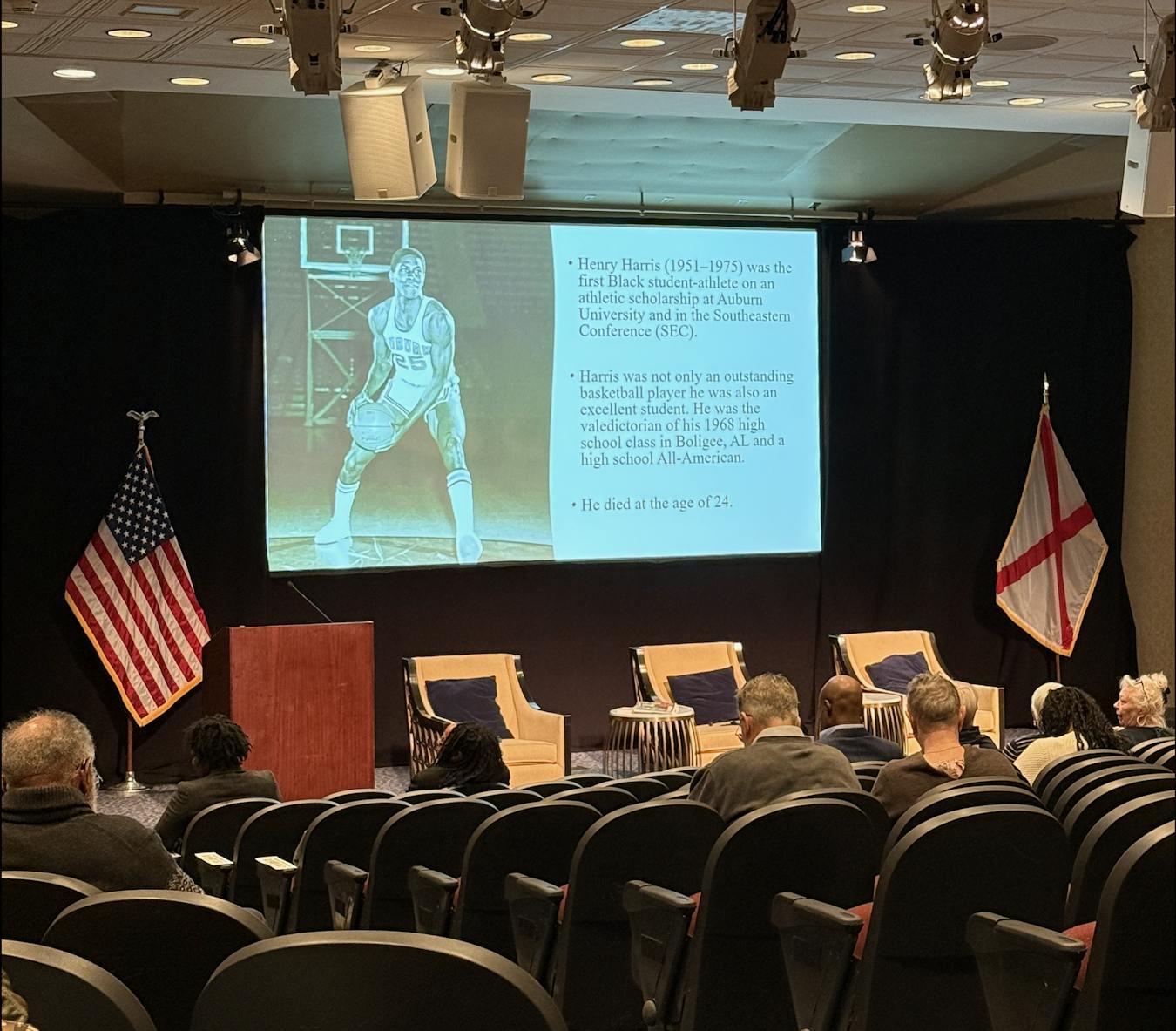
Slide on Henry Harris' achievements from Thom Gossom Jr. and Sam Heys' talk about their biography, “Just Follow Me: James Owens and the Integration of Southeastern Conference Football.”
Switching over to the story of Harris, Heys detailed how Harris’ athletic scholarship was revoked after playing on a torn ACL for the final five games of his junior year, being too injured to play. Too afraid to face his family and friends and without enough funds to stay at Auburn — as well as being turned down an assistant coaching job by the Auburn basketball coach — Owens worked at the University of Wisconsin-Milwaukee as a student assistant. Unfortunately, without a feeling of support, Henry died by suicide at the age of 24.
“He really was one of the first Blacks of any Deep South school in the SEC,” Heys said. “Clemson hadn’t integrated, Georgia, the Mississippi schools, so Auburn had made a tremendous, big ball move ... because of Henry’s talent ... but they weren’t ready for him to be a star."
Gossom connected Owens’ and his own story to other Black athletes at the time, whom were threatened, verbally or in letters, to be beaten, shot and even killed by coaches and sports supporters.
“While we were writing this book, [Heys] made the comment that we were teenage Civil Rights workers,” Gossom said. “I had never thought of it like that before.”
Within their own teams, the Black athletes tolerated derogatory insults, demeaning stereotypes and isolation. Gossom recalled a former Black teammate who eventually became so angry with the constant struggles and mistreatment that he quit the team. However, both Gossom and Owens persisted, paving the way for future Black athletes at Auburn.
“We were doing something that was gonna benefit many, many, many of us and the kids today that have benefited from the NIL. ... Owens said he wanted to quit every day, but he never left and he was never gonna leave,” Gossom said. “I wanted to make a difference. That’s why I stayed."
Gossom divulged that after graduating, he did not come back to Auburn’s campus for 18 years. However, he did end up attending his former football team’s reunion. He remarked that his white teammates had “grown a lot” and realized the historical magnitude of Owens’ and Gossom’s career as Black Auburn athletes. One freshman who Gossoms allegedly fought with everyday — much to Gossom’s surprise — hugged him.
“Neither one of us said anything. We just stood there,” Gossom said.
Vern Drayton, junior studying mathematics, was invited to the talk by Harrell, his former professor who believed he would be interested in learning about Owens’ and Harris’ stories.
“Learning about history and staying educated is so important,” Daryton said. “These kinds of events empower people. It helps to learn about other perspectives and see that not everyone experiences life the same way.”
After a brief round of applause, Harell thanked the authors and the family members and opened the discussions up to the audience for an informal questions and answers session. The audience asked brief questions looking deeper in Owens’ history, as well as personal insights into the racial discrimination Gossom faced and still experiences.
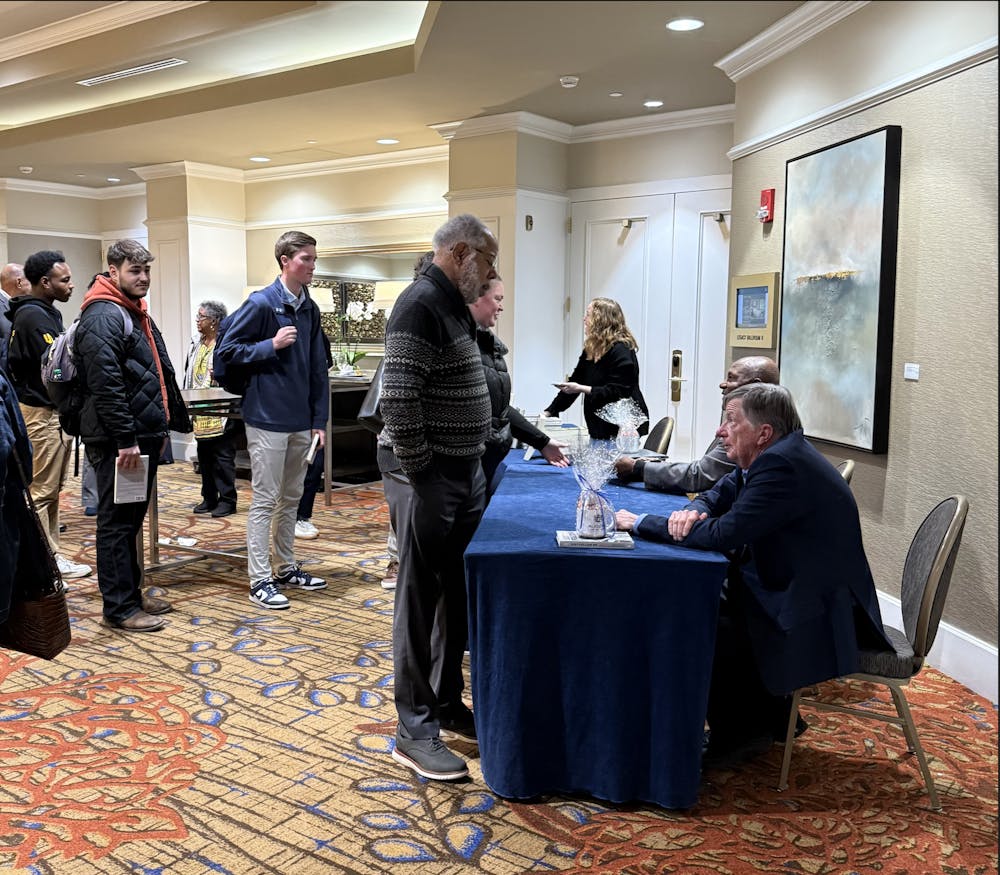
Dr. Harrell concluded the talk and thanked the authors and the family members for sharing and memorializing the courageous and authentic stories of Henry Harris and James Owens. The speakers went on to the tables just outside of the auditorium to sign books and converse with attendants.
Do you like this story? The Plainsman doesn't accept money from tuition or student fees, and we don't charge a subscription fee. But you can donate to support The Plainsman.