The Jule Collins Smith Museum of Fine Arts hosted the 2026 Auburn Forum for Southern Art and Culture as an all-day event on Feb. 7. The event ran from 9 a.m. to 6 p.m., featuring a series of exhibitions, speakers and other explorations of art originating from or inspired by the South, alongside its usual art displays. Entry to the event was free and various artists and speakers came to further explain their work.
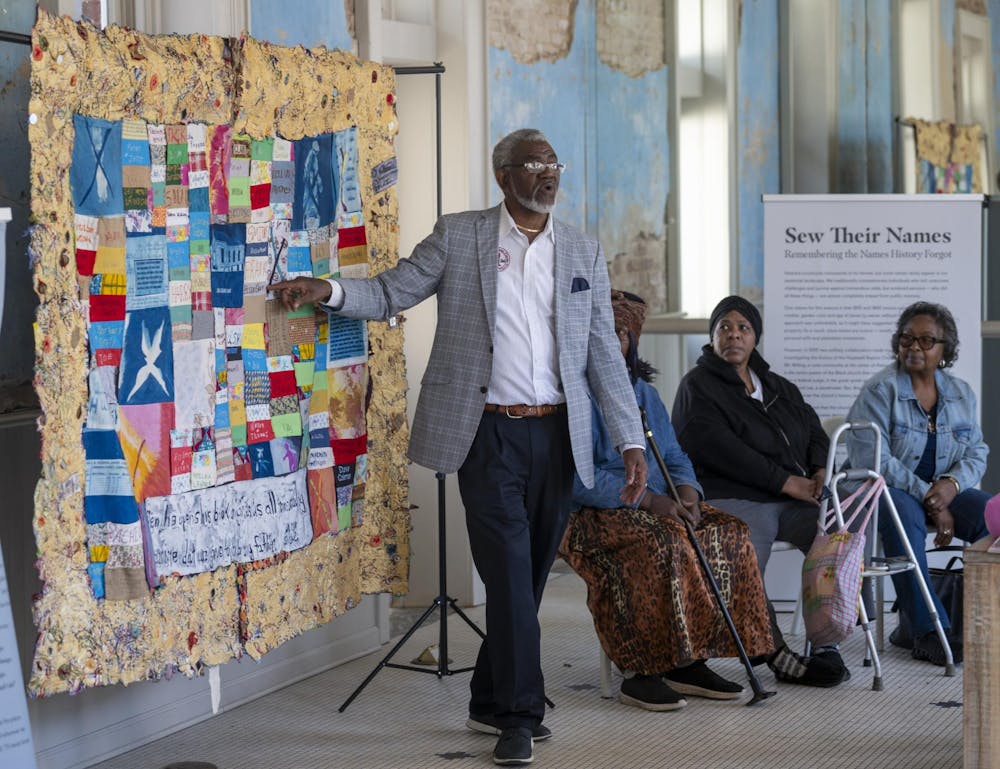
The main focal point of the forum was the “Sew Their Names” exhibition that was first opened in the museum on Jan. 20 and will last until July 2. The exhibition itself, a partnership between the Sew Their Name project and the Jule museum through the “Museum in Motion” outreach initiative, contains many hand-sewn quilts and other art pieces that form a narrative explaining the American story of Lowndes County and how art from various parts of Alabama and the south as a whole has acted as a vehicle for transformation, memory, activism and resistance for decades.
After a series of quilting workshops from 9 to 11 a.m., the afternoon section of the day’s events consisted of a poetry reading presented by Museum Director Cindi Malinick followed by three sessions of speakers who all came to discuss southern art pieces of all types, from painting and traditional art to quilting and written poetry. Malinick also gave an overview of the project, the hands behind it and the ideals of creativity and activism the exhibition promotes.
The first session of the afternoon was led by Nikki Silva with participants Judge Susan Walker and Rev. Dale Braxton and focused on the Hopewell Church owned by Braxton. The two of them spoke of the church’s sordid past in the 1800s when it was formed, and how that past helped Walker develop the main conceit of the Sew Their Names project which partially contains inscribing the names of every slave in one of the church's old attendance books on a quilt so that their names would not be forgotten.
Braxton also spent time telling his story, including his childhood growing up in the 1960s during the Civil Rights Movement, and how that shaped his life and ideals.
“It was rough,” Reverand Braxton said, “because they could do anything they wanted to you, and of course we really didn’t have a voice […] Growing up in Lowndes, it was hard, but I thank God I had a praying mother who told us ‘you are, and you will be, somebody.’”
The second session was facilitated by Elijah Gaddis and consisted of Leslie Umberger, Darby English and Es-pranza Humphrey. The first part of this session followed multiple African-American artists, the main example being Bill Traylor. Traylor was born to an enslaved family living on a plantation in 1800s Dallas County, Alabama. Bill was only 12 when the Civil War ended, and his family couldn’t afford to leave the plantation even after they’d been freed. After living on plantations for 20 years, Traylor left his former life behind and moved to Montgomery, Alabama. It was in the late 1930s when Traylor’s declining physical health led him to a life creating art. He survived a troubled past yet could only look forward to a future he would not live to see.
“He never learned a craft, such as basket weaving, but was familiar with art, both creative and utilitarian,” Umberger said.
Traylor’s work often focused on acting out stories from human history in abstract ways, capturing the themes of fear and escape. Traylor’s depictions of humans are elastic and almost shadow-like in nature, any human traits being shown not through word or expression, but through the contorted, wispy shapes that their bodies take. His messaging, told entirely through these silhouettes, is what made him such a sophisticated artist despite only beginning his work at the twilight of his life.
Later in the session, Humphrey, a speaker from the Poster House in New York City, took a moment to discuss the idea of posters and their significance to southern culture. One strong example is the Lowndes County Freedom Organization, also referred to as the Black Panther Party, who used posters to spread their messaging to the population of Lowndes County. They often used the image of the Black Panther due to the idea of self-defense. The main phrase attached to the party’s posters was “move on over, or we’ll move on over you,” which acted as a phrase warning against the continued segregation attempts and the rampant prosecution of African-American communities.
At the end of the session came a Q&A session with the three speakers, and the main topic for the session was what made Alabama, in particular, special for this type of art. Many points were brought up around the facts of Alabama’s deep ties to the Civil Rights Movements and its value to the history of slavery, which affects the all of America, north and south. English also had an interesting point about the intertwining of the arts and politics in the culture of Alabama.
“It’s so important to connect art and life, no matter how schooled we are to separate them," English said.
The final section consisted of the quilters behind the Sew Their Names project, namely Mercedes Braxton, Yvonne Wells, Wini McQueen and Charlie Lucas, discussing the project’s origins, meanings and the process by which it came to life. Mercedes Braxton described the project as a labor of love, beginning as a reluctant endeavor before growing into a method of emotional catharsis.
“I was approached, and I was told I had to do hand-stitching. I’d never done that before,” Mercedes said. “I’d never experienced slavery myself. I had to imagine things I went through as a child, and I had to put all of that into the quilt.”
Her quilt was titled “Oh, Freedom."
McQueen, a renowned cloth-based artist, described loving the idea from the very start.
“There’s not a lot of money in the south circulating for the arts, so it was a wonderful opportunity," McQueen said.
She later described the process she undertook of learning about all of the slaves whose names she was assigned to put into her quilt, adding images and symbols within the quilt to convey the stories and lives of the peoples’ names she was stitching. McQueen’s special style she employed in her section of the quilt includes a lot of fabric dyeing, and even some photo pressing. Her quilt was titled “Somebody’s Calling My Name."
Lucas was the third quilter to speak, and he also seemed very glad to receive the invitation to work on the project. He described it as “wonderful, as these were the voices I was already beginning to hear."
Lucas’s usual work is mostly made using scrap metal instead of felt, but he worked on the project anyway, using an old quilt made by his mother as the framework. He used this important idea of his mother and motherhood in general to inspire his quilt’s design. His quilt was called “I can hear the Voices.”
Finally, Wells mentioned the importance of identity within the project. Her quilt was religiously inspired, depicting a preacher sending the African-American members of the congregation into the church through the back entrance. She also described how difficult the process was, as it brought back memories of the painful stories she’d heard about slavery, and of seeing her family members going out to the fields. Her quilt was called “Worshippers at St. Willing Church."
The event as a whole acted as a celebration of southern artists of all kinds. In an interview with the Jule museum’s director of communications, Charlotte Hendrix, she explained that the purpose of the exhibition was to show the connection between activism and the arts in Alabama as a whole.
”I think it is that this area of Alabama, the Black Belt region, is rich in artistic production, but also activism, and they didn’t quite separate," Hendrix said. "It goes to this idea that art is life, and life is art.”
Hendrix also described the unique way the Forum itself was created, namely that the Forum came first and the Exhibition was created around it.
“A lot of times with museums there’s an exhibition and there might be an education program associated with it. This time, it was an education program that developed the exhibition," Hendrix said.
Hendrix also felt that the importance of the exhibition was shown through different perspectives and the artistic and cultural merit of such.
“That’s one of the things we aim to do at the Jule, is to open perspectives and dialogue, and that’s one of the outcomes we were looking for today," Hendrix said. "It was intergenerational. We had students, alongside community members. It was a very unifying experience.”
Do you like this story? The Plainsman doesn't accept money from tuition or student fees, and we don't charge a subscription fee. But you can donate to support The Plainsman.
Foster Mayhall, a freshman currently undeclared in engineering, is from Dothan, Alabama. He has been with The Auburn Plainsman since the spring of 2026.