The eagles that fly in Jordan-Hare Stadium aren't the only birds that can draw a crowd.
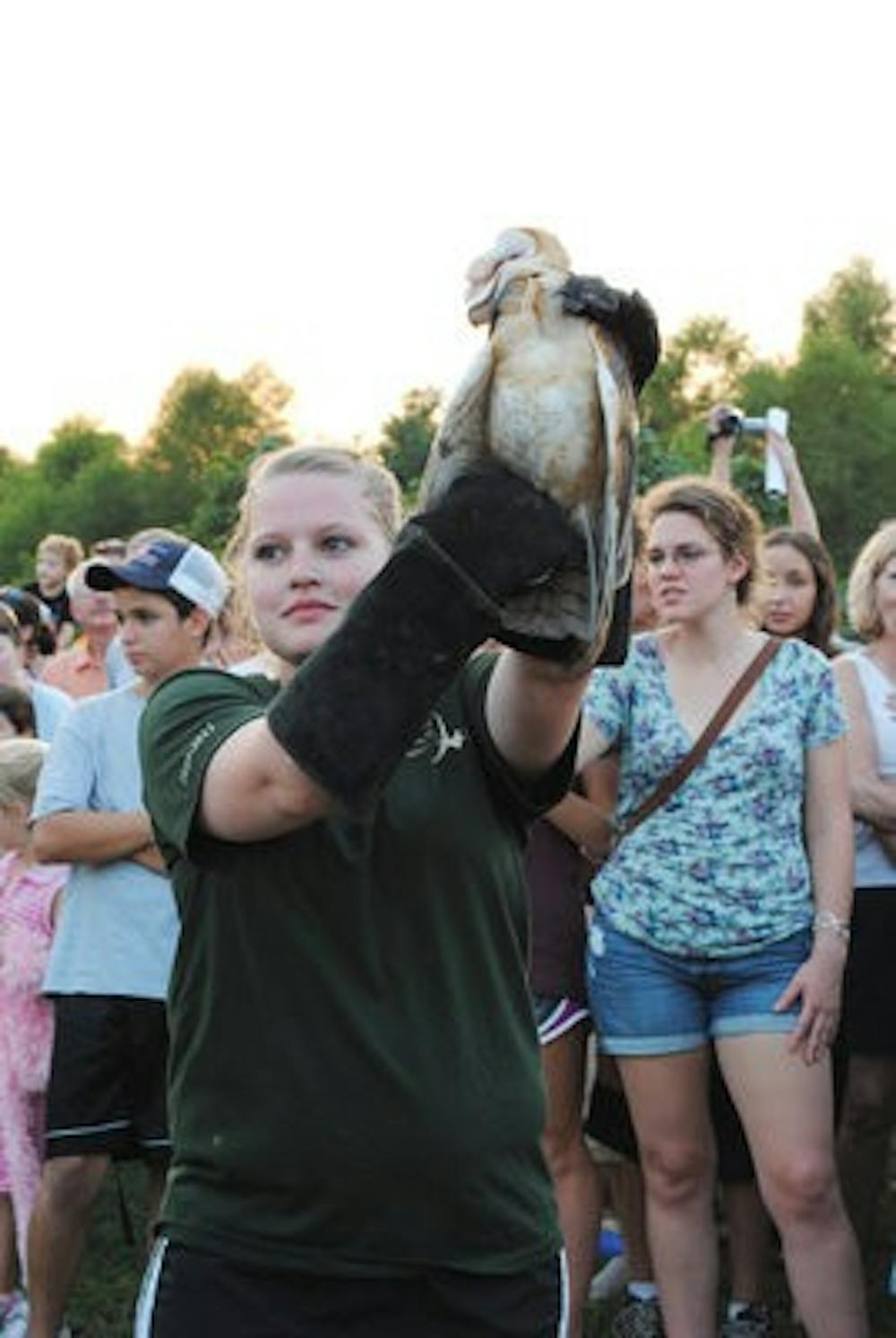
Five barn owls took flight from Town Creek Park last Thursday. The Southeastern Raptor Center at Auburn University staff released them after several months of rehabilitation.
"Four of them came from Albany, Ga., and they were found as orphans," said Liz Crandall, raptor rehabilitation specialist. "One was an adult that came from Montgomery, Ala., and she was just underweight."
Cars lined the road in front of Town Creek Park, and the open field was filled with people eager to see the release.
"I heard about it on the radio this morning, and then a friend e-mailed me about it," said Russ Jenkins, a teacher at Drake Middle School, who brought his whole family out to see the owls.
Lindsey Phillips, junior in forestry and wildlife science, is a student employee at the Southeastern Raptor Center.
She and many other student volunteers were at the park to aid in the release.
Phillips said the owls have only been at Auburn since the beginning of the summer.
The timing for when to release them was based on how they were doing medically.
"We do flight evaluations," Phillips said. "So it's based on how high they can get, how much elevation they can get off the ground, how long they can stay in the air, how well they perch, those kinds of things."
The barn owls were independent after Thursday.
Phillips said Auburn would not tag or track them in any way. This policy begins when birds are first taken in by the Center.
"What we want to do is take all precautions to not imprint them, so that they are still releasable," Crandall said. "We do our best to not expose them to humans a lot, to limit our time with them."
Human involvement is limited to the rehabilitation of the birds.
This involves providing a proper diet, a flight cage, protection from predators and a "foster parent," Crandall said.
"We don't name them because they're wild birds," she added. "We give them numbers. We don't want to treat them as pets or anything like that."
Student volunteers released the owls as the audience cheered.
In true Auburn fashion, like the eagles on game day, the last owl circled the silo at Town Creek Park before flying away.
The birds took off in different directions, and Crandall said that is not uncommon.
"One study that was done in Utah showed that they could go anywhere, from less than a mile from where they were born to over 900 miles," Crandall said. "Usually, they want to go far enough that they don't breed with their siblings or anything like that."
The four birds found as orphans were from the same clutch, which means they were hatched at the same time.
There is some uncertainty as to how these birds will fare in the wild because of unpredictable circumstances, but Crandall said their chances are good.
With the ability to hear and see in almost complete darkness, to determine the size and type of prey just by listening, and to fly soundlessly, these birds' main challenge is finding a habitat, Crandall said.
"There's no reason why they shouldn't be able to hunt on their own, to find a mate or anything like that," Crandall said. "As long as they can find a suitable habitat, they should be OK."
Do you like this story? The Plainsman doesn't accept money from tuition or student fees, and we don't charge a subscription fee. But you can donate to support The Plainsman.