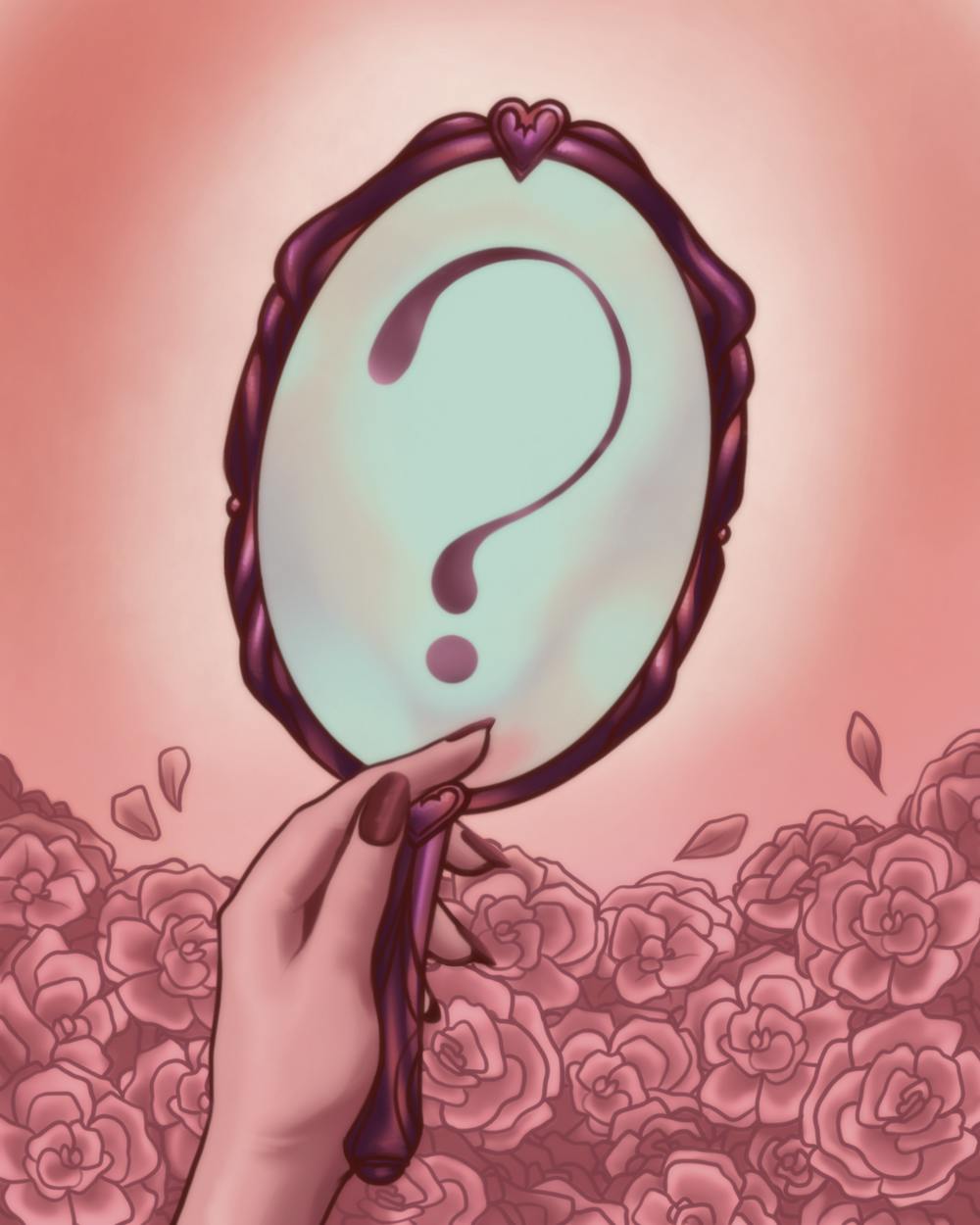
I have found that college brings a frequent experience of being in a class you don’t really understand but have to take. The professors, or at least the good ones, will normally say something along these lines at the beginning of the year: "To memorize is not enough to do well on the test. You will have to understand it enough to apply it.”
Meanwhile, in the world of academia centuries ago, Socrates urged a similar principle: "know thyself." To "know thyself" is an idea he discussed in multiple of the Platonic dialogues, and it's a phrase I think most people have heard. Broadly, his premise was to create a society that was intelligent in matters of the heart and mind.
Now, in place of this familiar phrase “know thyself,” most of us in the 21st century have been urged to “love ourselves.”
On nearly every media platform, modern influencers and experts alike encourage lifestyles of self-acceptance based on "love." However, as I see it, repeating words of self-love to ourselves puts us at a disadvantage; the waves of the “self-love movement” are one of the main tools we use to cut corners around ourselves and make our own lives a tiny bit easier.
It’s like trying to memorize the information for the test instead of learning how to apply it yourself. As soon as life throws you one curveball question you weren’t expecting, you’re completely knocked off your feet.
Although there is some merit to the mantra of “loving yourself,” it’s often used as a blanket term to cover an absence of real self-awareness or responsibility. The reason for the popularity of this movement is simple: What you can't or willingly choose to not understand about yourself is easier to accept than what you know about yourself but cannot accept. Loving ourselves blindly gives us the opportunity to ignore, instead of overcome, those negative or harmful traits that may require self-reflection.
This willful ignorance is just like being in a difficult class that requires application, not just memorization. Obviously, learning and applying can be painful at first, but these are ultimately the most reliable approaches to facing the test with confidence.
Here is another example. “I choose to love myself anyway” is what a girl might tell herself after a breakup, to help her move on.
And her ex might tell himself the same thing, albeit maybe not in those exact words, to remind himself he’s better off without her.
Neither of them can figure out why their relationship didn’t work. They cling to their own version of self-love in order to move forward, because they don’t know each other or themselves enough to discover what really went wrong or how they can avoid it in the future.
“To really get to know yourself, you must be open to the possibility that the 'real' you is not altogether a positive person,” said Dr. Gabor Mate, esteemed Canadian physician, psychotherapist and bestselling author of "The Myth of Normal."
Just like the answers memorized for the test, sometimes you might catch yourself answering questions with recitations of the mantras you see online or listen to in music. Or you may discover that acting in ways that align with principles of self-love somehow do not even remotely get you closer to liking — much less loving — yourself.
Generally speaking, I argue we don’t answer to others or ourselves honestly, because we don’t know ourselves enough to determine the honest answer.
This absence of real awareness, sloppily coated with blind acceptance, is one of the scariest things about our generation. It makes trusting others difficult, it makes self-confidence a losing game, and it grants us the belief that the world is simpler than it really is.
But again, choosing to think critically is hard — especially about yourself. Most of the time, it’s much easier just to accept the answer that's been handed to you.
So what can be done? This is the hard part, and my guess is that it will look different for everyone. But following the wise professors' advice to understand rather than recite is a good place to start, and I think it might make our grades, ourselves and our love lives a little bit easier to look at this Valentine's.
Do you like this story? The Plainsman doesn't accept money from tuition or student fees, and we don't charge a subscription fee. But you can donate to support The Plainsman.