Frankly, the news has been exhausting over the past couple weeks. If you’ve been paying attention at all, you’ve probably read headlines about U.S. military operations in Venezuela and possible operations in Iran. You’ve probably heard about the conflicts between the citizens of Minnesota and ICE, and you’ve probably seen the death of Renee Good and Alex Pretti from multiple angles.
With how grim the news has been, it may seem simpler to plug our ears, bury our heads in the sand and wait for things to cool down. After all, the events that take place in Minneapolis or Venezuela can often feel like they don’t have an effect on the population of Auburn and Auburn University.
But we must recognize, immediately, that such feelings are farcical at best and harmful at worst. In many ways, the warmth and love that the Auburn Family is known for has been replaced with division and open vitriol.
Last week, a young man on his way to roll Toomer’s Corner shouted passionately about Mexicans, saying that we should, “shoot ‘em all!”
This is not the first time something like this has happened. Around this time last year, when Auburn received the heaviest snowfall it'd gotten in ages, someone took the time to write a racial slur outside Sasnett Residence Hall.
While the largely White population of Auburn may see events like this as trivial “jokes,” statements like these are symptoms of a larger problem — a widening gap as to what news people are consuming and what people consider “normal.”
The problem that we have today is not about getting access to news, but rather the quality of news that we are getting.
Today, many people get their news from X, Facebook, Instagram or TikTok. The problem with shopping news from social media is the simple fact that these platforms don’t care about fair, honest news coverage. Instead, the purpose of these platforms is to incentivize endless scrolling.
Social media algorithms thrive off engagement, not accuracy. Thus, the way they treat the news is insufficient. Instagram doesn’t care whether a video is AI or spreading misinformation, it cares about how long you watched or engaged with it. Content creators are, in turn, incentivized to create content that has the most potential for views, rather than content that is "balanced."
Because of this, the way we view the world is increasingly divided. It’s hard to have conversations with someone else when you're constantly stuck in social media echo chambers that are only broken to show you content that is intentionally inflammatory.
The effect this has had on our culture is tangible. People begin to believe that whatever they see online is a normative position. They begin to believe that rhetoric like "shoot 'em all" is a sentiment that people share outside of Instagram comment sections. Social media has pitted us into a never ending war against "The Other Side," which has made it easy to neglect the humanity of others.
We recognize that people have differing beliefs about subjects like immigration; disagreements like that are natural and are healthy for our political process. However, what is not natural is the use of slurs or rhetoric as mentioned above. Comments like those exacerbate the growing divide in our society.
This division is not a problem that is exclusive to social media. Today, it seems that all news that people get is filtered through a partisan lens. When a major news event happens, you are certain to see Fox News and CNN filled to the brim with different commentators lining up to prove that their side is “right” as opposed to simply covering the facts of what happened.
Part of the problem is that non-biased news simply isn't in demand. We have a natural inclination to seek out people who agree with us because it feels good to have our own opinions affirmed. Networks have no reason to attempt to be unbiased because being partisan is much more profitable.
In order to fix this, it is necessary that we recognize the role that we play in it. While social media and television have an incredible ability to share information, they should not be your only news source. Instead, in an age where information is more accessible than ever, it is critical that we spend time researching and reading about current topics.
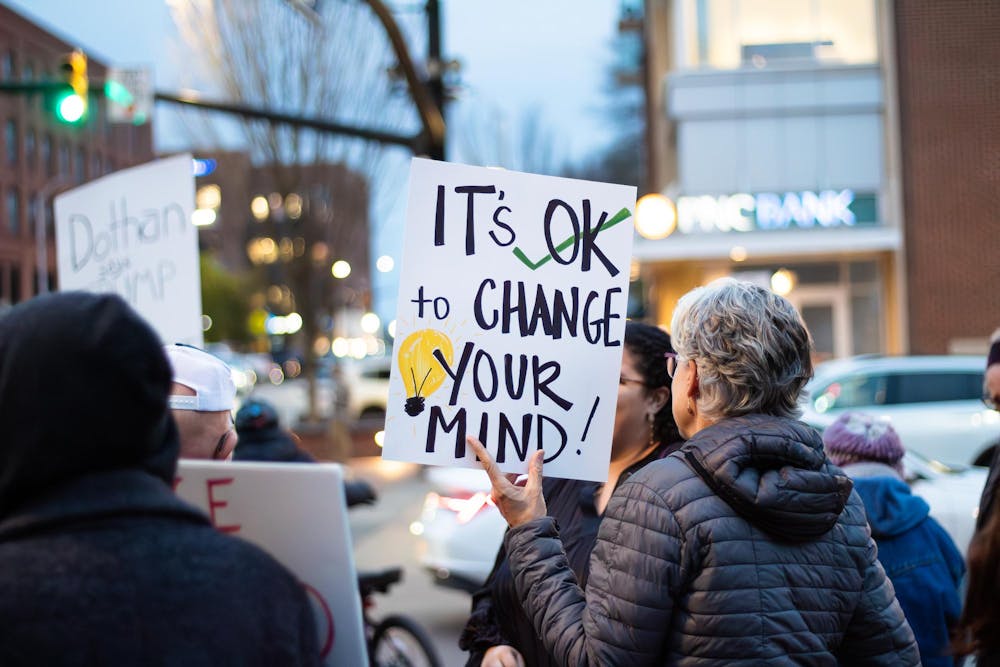
While advancements in technology have made us more connected than ever, they have also driven enormous rifts between us. The only way to bridge these gaps is to stop characterizing large swaths of people as your enemy — the way that partisan news sources and social media wants you to. Now, more than ever, it is critical that we engage with people outside the bounds of the internet. Having real discussions with people that you may disagree with is a crucial first step to fixing the division plaguing our society today.
Do you like this story? The Plainsman doesn't accept money from tuition or student fees, and we don't charge a subscription fee. But you can donate to support The Plainsman.
Jordan Wright, sophomore majoring in Law and Justice, has been with The Auburn Plainsman since January 2025. He is currently serving as the Opinion Editor.