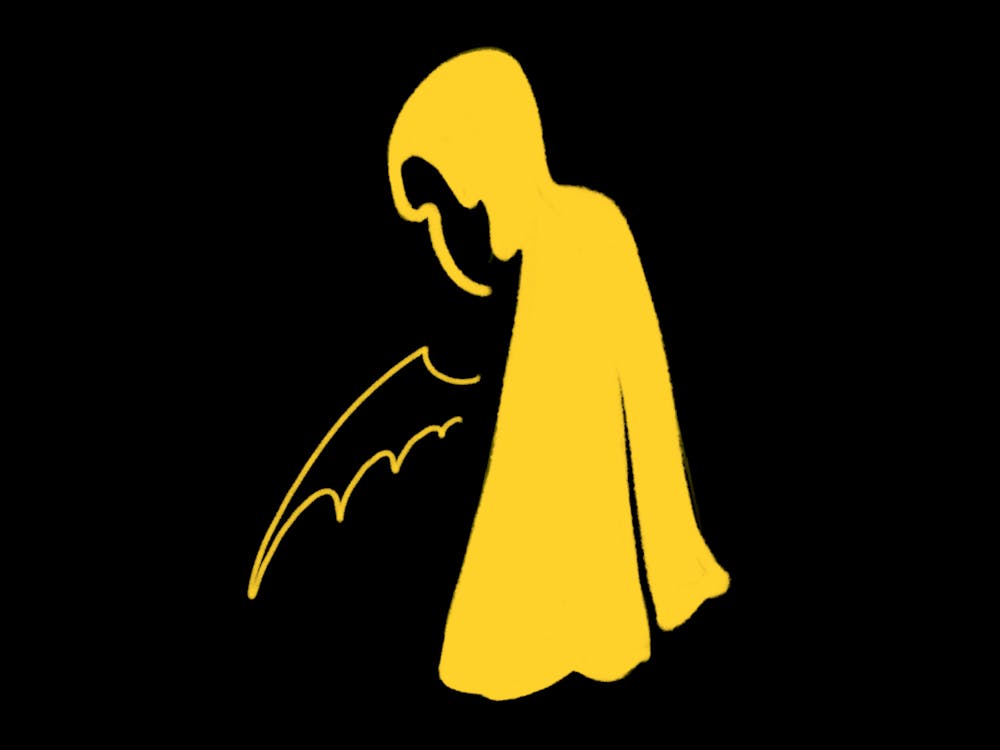
For almost 150 years, horror author Robert W. Chambers' "The King in Yellow" has entrapped the minds of artists and readers alike. No matter where you turn, this collection of short stories has served as inspiration across the arts, from books to video games to television, while its namesake entity lurks, silently watching from the shadows.
To understand the eventual impact of "The King in Yellow," we must analyze the 1895 collection it is found in, with short stories ranging from weird fiction and cosmic horror to romance. Like the figure for whom the collection is named, the assortment is a strange one.
Most well known are the first four stories: "The Repairer of Reputations," "The Mask," "In the Court of the Dragon" and "The Yellow Sign." Each of the short stories are set in the same universe.
In the story in which the Yellow King first appears, a recently published play has taken the world by storm, condemned for its vile nature and spoken of only in hushed whispers by members of polite society. The in-universe play is entitled "The King in Yellow," which is not to be confused with the title of Chambers’ short story collection, and it is said that those who read the play are driven insane once they reach the end of the first act.
The start of the second act reveals some unknowable, terrible piece of forbidden knowledge so powerful that it drives artists to ruination, filling their minds with visions of the Yellow King and of a distant land called Carcosa. We as the readers never find out what horrible truth lies on the first page of act two. The play has a varying effect on its readers, driving some nearly instantly mad, while inspiring others to create wondrous inventions and masterpieces that ultimately spell doom for their creators.
This first iteration of the story flew under the radar until it was picked up and read by author H.P. Lovecraft, and it eventually served as a massive inspiration for his mythos and storied career. After Lovecraft created Hastur, his own take on the King in Yellow who also acts under the same moniker, in his 1930 novella "The Whisperer in Darkness," Chambers’ work found a wider audience. Lovecraft would later develop Hastur into one of his Old Ones, his pantheon of fictional deities, and make him the half-brother of Cthulhu, which is confusing enough on its own.
For a story that isn’t widely discussed in modern pop culture, the reach of "The King in Yellow" stretches further than one would think. More recently, Stephen King adapted the King in Yellow into the Crimson King, the antagonist of the final novel of his eight-book bestselling "The Dark Tower" series. Even the Yellow Sign, the fictional symbol associated with the King in Yellow to show madness and forbidden knowledge, was brought over, taking instead the form of a red eye that fulfills the same role within the story.
The influence even expands into the modern tabletop games Warhammer and Dungeons & Dragons. For as little as I know about Warhammer 40,000, "The King in Yellow" was also loosely adapted into that far-spanning mythos as Magnus the Red, also known as the Crimson King. Similarly, Dungeons & Dragons adapted the Yellow King himself under the name Hastur the Unspeakable, inspired heavily by Lovecraft and even referring to Hastur as part of the "Great Old Ones."
It wasn’t until 1994 that the King in Yellow inspired its first on-screen adaptation in John Carpenter’s "In The Mouth of Madness," starring Sam Neil and Julie Carmen. Interestingly, this was also the first role of Hayden Christensen, who briefly played a young paper boy in the movie before eventually playing Anakin Skywalker in "Star Wars." Informally, Carpenter referred to the film as the third and final installment in his “Apocalypse Trilogy,” following "The Thing" and "Prince of Darkness."
In 2014, "The King in Yellow" garnered its most famous and arguably best adaptation to date: the Emmy Award-winning season one of "True Detective," starring Matthew McConaughey and Woody Harrelson as Louisiana state troopers investigating a series of ritualistic murders. In my opinion, it is the singular best season of television ever created, and I truly cannot recommend it enough.
"The King in Yellow" also was adapted into several video games, from old-school platformers like Sega’s 1991 "El Viento" to more modern games like "Fear & Hunger" in 2018, "The Yellow King" and "The Baby In Yellow" both in 2020, "Sucker For Love" in 2021 and, most recently, the award-winning survival horror game Signalis in 2022.
There have also been innumerable short films, with the most recent being "The King in Yellow" in 2025. This film is a modern take on Chambers’ story, following three college students who read separate parts of the play for a research assignment, but the issue arises when one of them reads more than they should have.
I only recently discovered "The King in Yellow" through a documentary by the YouTuber Wendigoon, who provided a deep dive into the original collection of short stories. This video piqued my interest and eventually inspired me to write a novelized detective noir/cosmic horror adaptation of my own take on "The King in Yellow" mythos. In writing that book, I was led down an extensive rabbit hole that manifested into this article.
Now, one may ask, why I am playing six degrees of separation with Chambers' short story? This is a valid question. I suppose I find it fascinating that a relatively unknown short story collection from the 1800s has had a hand in some of our most beloved works of fiction and media at large. Just like in Chambers’ story, the King in Yellow has woven his way into the minds of artists and writers, transcending generations to supplant his Yellow Sign.
The question is… is it too late for you?
Have you seen the Yellow Sign?
Do you like this story? The Plainsman doesn't accept money from tuition or student fees, and we don't charge a subscription fee. But you can donate to support The Plainsman.
Logan Myers, freshman majoring in journalism, is from Hilton Head Island, South Carolina. He has been with The Auburn Plainsman since the fall of 2025. In his spare time, he writes short stories and novels in the horror/thriller genre and enjoys camping.